Tyler Cowen and qualia

Tyler blogs about qualia today here. Qualia are of course the subjective experiences that occur as part of our conscious selves when we see something like the color “red”. The argument is whether my subjective experience of red is the same as yours? This is an interesting question. It’s quite separate from the cognitive process of labeling things as “red”. It’s the experience of “redness”. As pointed out, my experience of “redness” might well correspond to your experience of “blueness”. It’s something inside our conscious selves that we can’t share. That in spite of natural selection and our visual color system (to say nothing of language) causing us to label red frequencies of light as “red”.

Experience is part of what David Chalmer’s calls the “hard problem” of explaining consciousness. You can read more about that here.

Response to Tyler’s "Sobering Thought" Blogpost

Tyler’s quite interesting short post on American Higher education is here. The money quote:

In other words, I work in what is perhaps the most competitive and successful sector in the most competitive and successful economy of all time.
And yet what I see around me is a total, total mess.  And I believe my school to be considerably above average in terms of how well it is run.

My sense is that he’s on to something here in that higher education is a mirror to the larger society in which it is embedded. Cowen had just blogged previously about David Brooks Two Economies (perhaps the 21st century’s version of C.P. Snow’s Two Cultures). Central to Brook’s thesis is that there are two economies these days in the US and they are growing ever more separate. Here is Brooks riffing on Tyler’s own recent work:

His work leaves the impression that there are two interrelated American economies. On the one hand, there is the globalized tradable sector — companies that have to compete with everybody everywhere. These companies, with the sword of foreign competition hanging over them, have become relentlessly dynamic and very (sometimes brutally) efficient.
On the other hand, there is a large sector of the economy that does not face this global competition — health care, education and government. Leaders in this economy try to improve productivity and use new technologies, but they are not compelled by do-or-die pressure, and their pace of change is slower.

One gets the impression that Brooks sees American Higher Ed as being firmly ensconced in Economy 2, while Tyler in his blog post sees it as being in Economy 1.

I think American Higher Education is mirroring the larger American Economy and that there are elements of both Economy 1 and 2 in the Academy. Further, the “mess” that Tyler sees around him is simply an accurate reflection of the tensions that Brook refers to in his column:

A rift is opening up. The first, globalized sector is producing a lot of the productivity gains, but it is not producing a lot of the jobs. The second more protected sector is producing more jobs, but not as many productivity gains. The hypercompetitive globalized economy generates enormous profits, while the second, less tradable economy is where more Americans actually live.
In politics, we are beginning to see conflicts between those who live in Economy I and those who live in Economy II. Republicans often live in and love the efficient globalized sector and believe it should be a model for the entire society. They want to use private health care markets and choice-oriented education reforms to make society as dynamic, creative and efficient as Economy I.

As long as we have STEM fields viewed from an Economy 1 prism and Humanities viewed from Economy 2….well, that’s pretty much a recipe for the perception of a mess, even at a well run place like George Mason. Oops, we’re back to C.P. Snow and Two Cultures….

Tyler Cowen’s vision of a new American Century?

His 4000 word essay in American Interest is here. It’s a pretty positive vision of an american future that would be export-based. Shale gas, MITx courses and robotics all play important roles…along with maturing developing countries that develop a real taste for what we make best. I worry that he doesn’t factor in externals such as climate change, food production ceilings and the propensity for our primate brains to get the best of us. But it’s an important piece and it helps counter the declinist conventional wisdom.

Science Investments…

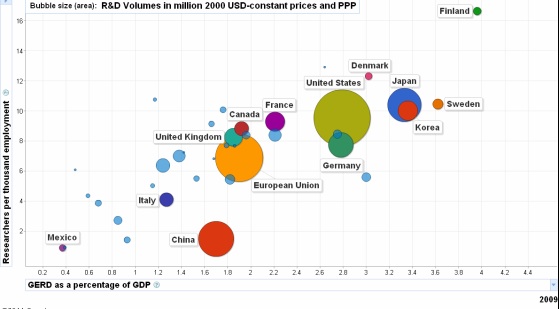
They are something we do here at the Institute level when we buy a new piece of shared equipment, but they are also something a nation does when it sponsors R&D through agency grants programs or through national laboratories.  The below graph (full movie presentation go here) shows 2009 OECD data for researchers per 1000 employees (y-axis) versus National R&D as a percentage of GDP (x-axis). The bubble size adds a third dimension: non-normalized national R&D. What jumps out pretty clearly is that Finland is investing in science at a very high level. And, that the US, if one normalizes by either population or GDP isn’t the leader.

Although the public often sees these investments through the lens of the deficit, the larger context is a nation’s ability to grow its way out of its fiscal problems as opposed to deflation and massive deleveraging. Science investments create the “garden” environment for the next wave of technology revolutions that Tyler Cowen talks about in his recent book, The Great Stagnation.

How is science investment paying off for Finland? Having recently returned from Helsinki, I can report first hand evidence of a vibrant technology start-up community, perhaps Europe’s most healthy economy, and a K-20 education system that is a world-leader. To me those are side-payoffs from the science investment. And they are very important.

However the central payoff from national science investment is the increased probability of a “game changer” discovery that leads to a revolution on the scale of the Industrial Revolution. Because science is serendipitous as far fundamental discoveries are concerned, we can’t forecast them with any accuracy. What we can do is invest as much as possible so that the probabilities of great discoveries go up.

Fermi Paradox Discussion continued….

Started yesterday between Tyler and myself by email, now over at Marginal Revolution.

To continue: if we are not in a simulation, then the question of “why the silence“?

Until recently, one idea was that the step from prokariyot (bacteria for example) to eukaryote (us and other complicated plants and animals) was the big filter, but the most recent evidence doesn’t support this notion.

I still think the filter idea might be operative, but at a much later point–when intelligent civilizations acquire the keys to thermonuclear reactions (aka, the bomb). Now we’ve been lucky for about 60 years, but that’s the blink of an eye in cosmological time. I’m not at all convinced that our luck will hold out.

It’s been said that a “Day After Tomorrow” full out nuclear exchange is no longer in the cards, but I recall seeing a Rand study (pdf), that indicated even a single nuclear blast in LA Harbor would be enough to bring down the US through follow on consequences across the economy and geopolitical sectors.

Note added in correction: A reader reminded me that the movie I’m referring to is The Day After…for which I am grateful.

Brookings Hamilton Project

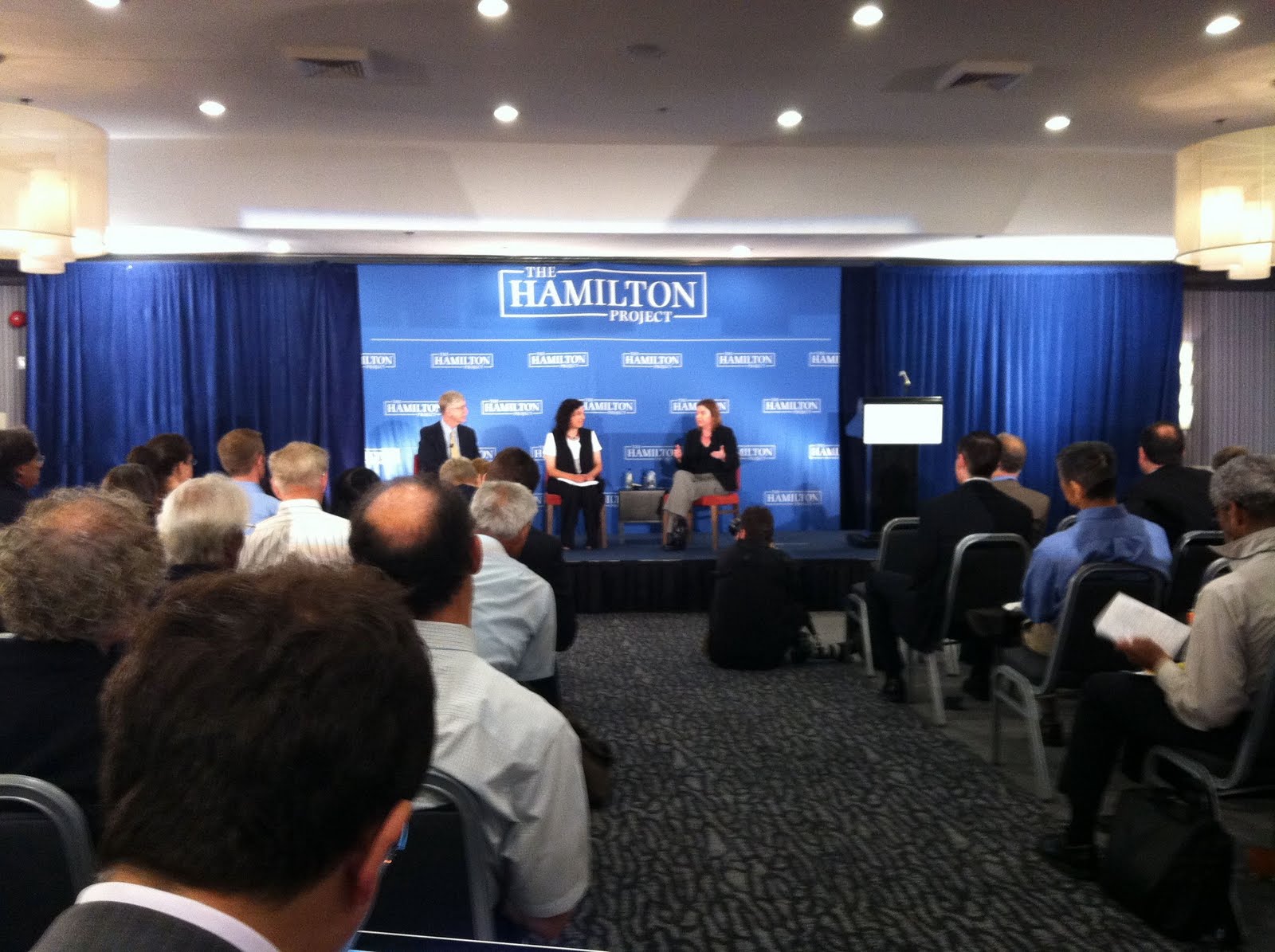
Left to Right: NIH Director Francis Collins, Moderator Ann Kellan, MIT’s Angela Belcher 

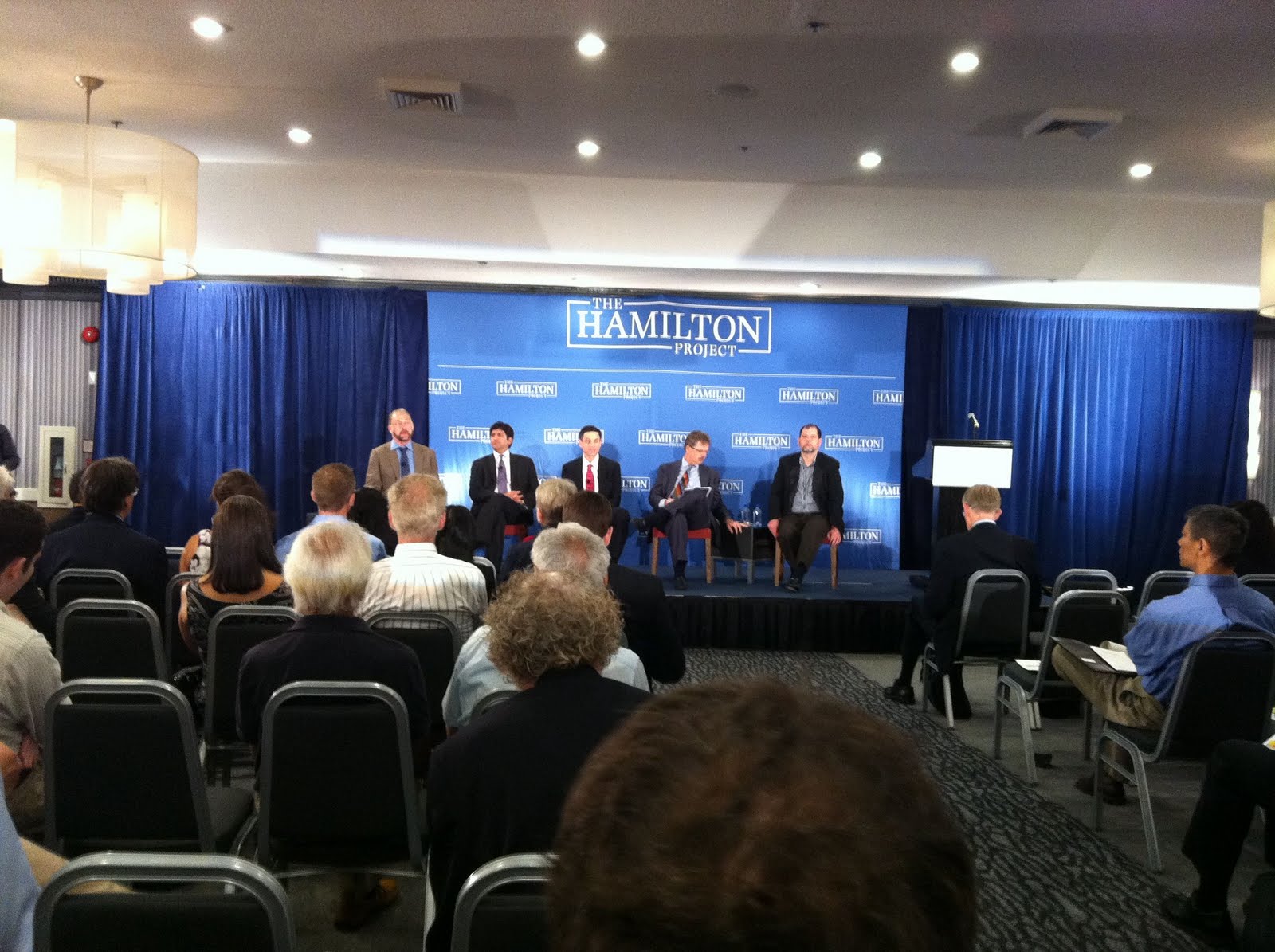
Left to Right: Tim Bresnahan, Anesh Chopra, Michael Greenstone, Glenn Hutchins and Tyler Cowen

Brookings’ Hamilton Project is about America flourishing, to use the term of positive psychologists.  This morning’s symposium on Capitol Hill was entitled “PhD’s, Policies and Patents: Innovation and America’s Future”. I stayed as long as I could through the first two sessions.

NIH Director Francis Collins had two really interesting ideas that are relevant to what we do at Krasnow. The first is the notion that “the genome is a bounded set of information”. Of course that is what gives power to bioinformatics (Mason gave birth to what I believe was the US’s first degree program in this field). But it also shows the way to Collins second big idea: “hypothesis limited research”.  This of course in contrast to the Popperian hypothesis-based research. In other words, use the boundedness of the genome to discover the full set of answers to a scientific question (e.g.: tell me all of the genes expressed by a pyramidal neuron).

Chopra had another interesting idea: that we lack an instrumented medical system, educational system and power grid. In other words, policy makers can’t get at the real-time granular and aggregated data. He also characterized the Administration (where he serves as CTO) as an “impatient convener”. Well, with the debt limit crisis coming to a critical phase, I’d say that’s a pretty accurate description of what the President’s got in front of him over the next four weeks.

Finally, my colleague Tyler Cowen went beyond his new book, The Great Stagnation, and talked about an agenda for studying historical episodes where great innovation has taken place (his example is late 19th century Hungary) without obvious prerequisites being met.

I also ran into Krasnow Advisory Board Member, Elizabeth Marincola.

All told, an interesting morning.

Solar Power close to economic feasability?

At today’s Financial Times here. My colleague Tyler Cowen isn’t convinced and brings up a mismatch with another of today’s headlines at Marginal Revolution.

My sense is that over the long haul, solar power is the big Kahuna of renewables. But the key technological advance may be some ways in the future–if we can capture solar flux directly in space and the packetize it for delivery here on Earth.

In the meantime, the existing solar capture technologies are all intriguing, from artificial photosynthesis to better photovoltaics.

The China Meme

We’ve all seen it over and over, for the past decade. In today’s FT, four new books are reviewed that put forward a potential counter-meme: namely that the US has some crucial advantages going forward. My only worry: Tyler Cowen’s thesis that those US advantages don’t necessarily translate into jobs.