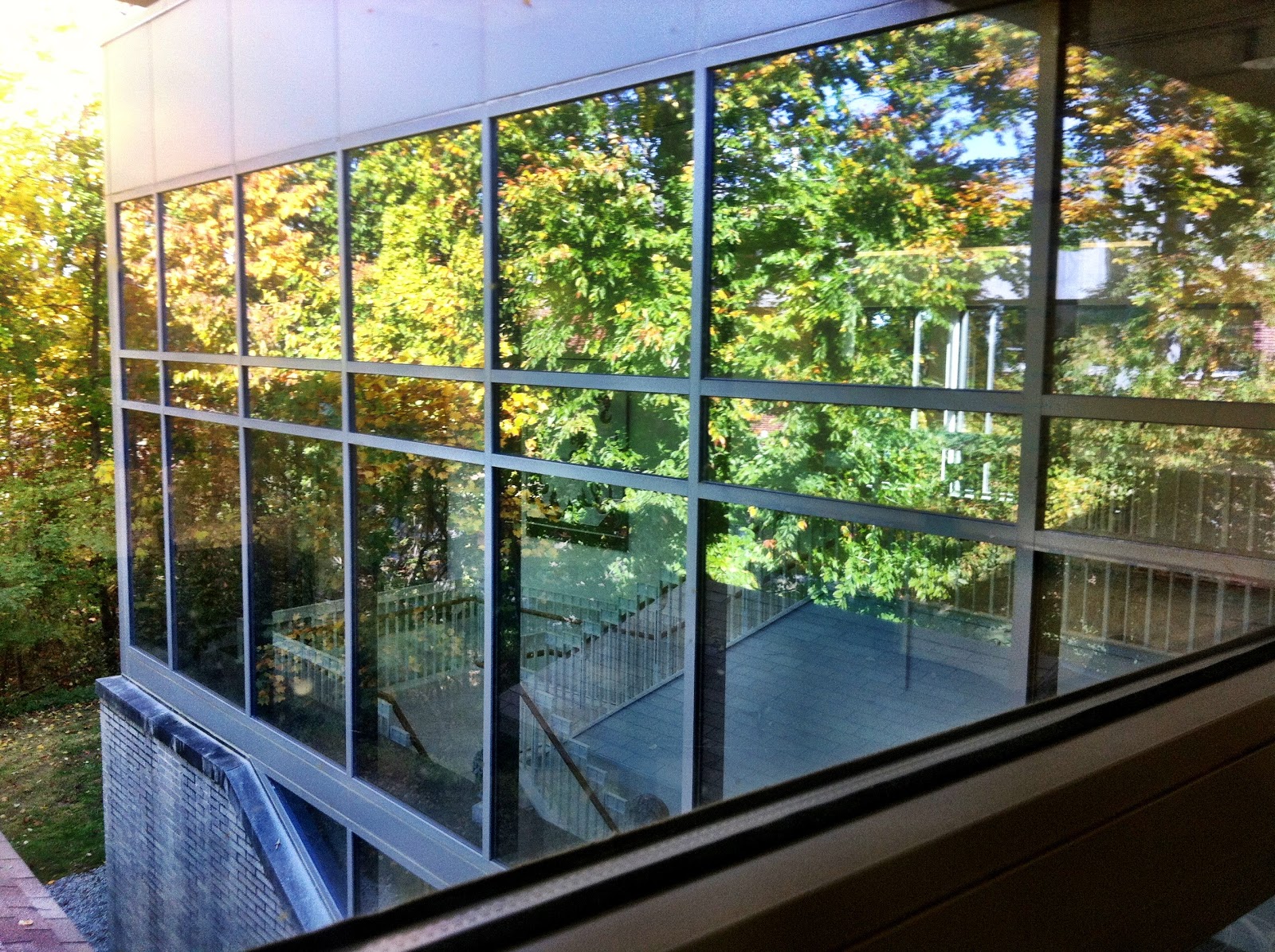
Fall reflections…

The view out my office window: Krasnow Institute for Advanced Study

Fall semester is pretty much half over here at George Mason. Over the past two days, after my return from China, I’ve had time to reflect on the incredible dynamism of the science that goes on here…

An example: today I got to see some absolutely spectacular results that may be relevant to interactions between the brain and the immune system–to my mind, an understudied critical physiological axis in developing new treatments disease.

In the meantime, I’ve been reading up on the default mode network–the system in our brain that seems to subserve mind wandering. Specifically, I’m interested in what happens when the function of this network goes awry (for example in schizophrenia). But the larger question is this: how does the neural dynamics of our brain play out in our complex human social interactions? Can my default mode network affect yours? Time for us to hire some social neuroscientists?

Cultural neuroscience

This is a potentially very controversial term that I first learned about in Singapore, about a year ago. The notion is that culture has the ability to affect our neurobiology. This is not so far off from the question Nicholas Carr as asking a bit back–can Google make us stupid? Clearly, there’s a valid line of research on adult brain plasticity driven by our environment. My own research and that of many other colleagues completely supports this idea.

The above intriguing idea is whether a culture, in the anthropological sense, has the ability to influence brain connectivity above the between- and within-subject variability of a population?

Putting it another way, given the fact that any two of us (from the same culture) have differently wired brains, can our shared culture influence both of our brains in some measurable way that rises above the threshold of natural variance in the cultural group to which we both belong?

My gut sense is no. But as far as I can tell, there is no data out there to make a scientific case upon, one way or the other.

Note above all, that this is not the same question of whether population genetics can influence brains. Although without a doubt culture is an emergent of many brains, and the instruction manual for constructing those brains is in our genes.

But to learn more, next June in Ann Arbor….

The art of compromise

Well, I have to admit, I’m relieved that Congress and the President came to some sort of agreement last night. Shutting down the Federal Government would have been just incredibly disruptive to science, particularly the important biomedical research being conducted by our colleagues on the Bethesda campus of the National Institutes of Health.

Which brings me back to the subject of compromise. It would be interesting to design a brain imaging experiment which studied compromise. Just outside the boundaries of neuroeconomics, this would be a social neuroscience experiment with political science overtones…..the underlying question is whether there are subtle individual differences between those prone to “split the difference” and the “take no prisoners” folks.

On further search: see the work of Drew Western, who apparently was on the team that imaged partisan Democratic and Republican party members with regards to the 2004 presidential campaign and is the author of a book, The Political Brain.

Social neuroscience

Many loyal readers know that I’m an avid fan of the Saturday Financial Times–in many ways superior to the Old Gray Lady’s (NY Times) Sunday edition–just my opinion. 

Here’s a really interesting article about Ohio State University’s John Cacioppo and his research on the neurobiology of loneliness. My sister, a psychiatrist, has written about the subject in her book (written with her husband, also a psychiatrist) Overcoming Loneliness in Everyday Life. But Cacioppo’s approach is different–his research appears to reveal a gene network that is triggered by loneliness with potentially lethal affects. And perhaps more importantly the notion of a new subfield: social neuroscience.
Jim