
A new year long project called “Neurodata without Borders” is taking shape, story here. A necessary step for sure. I would argue that the Hippocampome and NeuroMorpho.org do something very similar, but in different domains.
Category: NeuroMorpho.org
The Institute and digital reconstruction of neurons
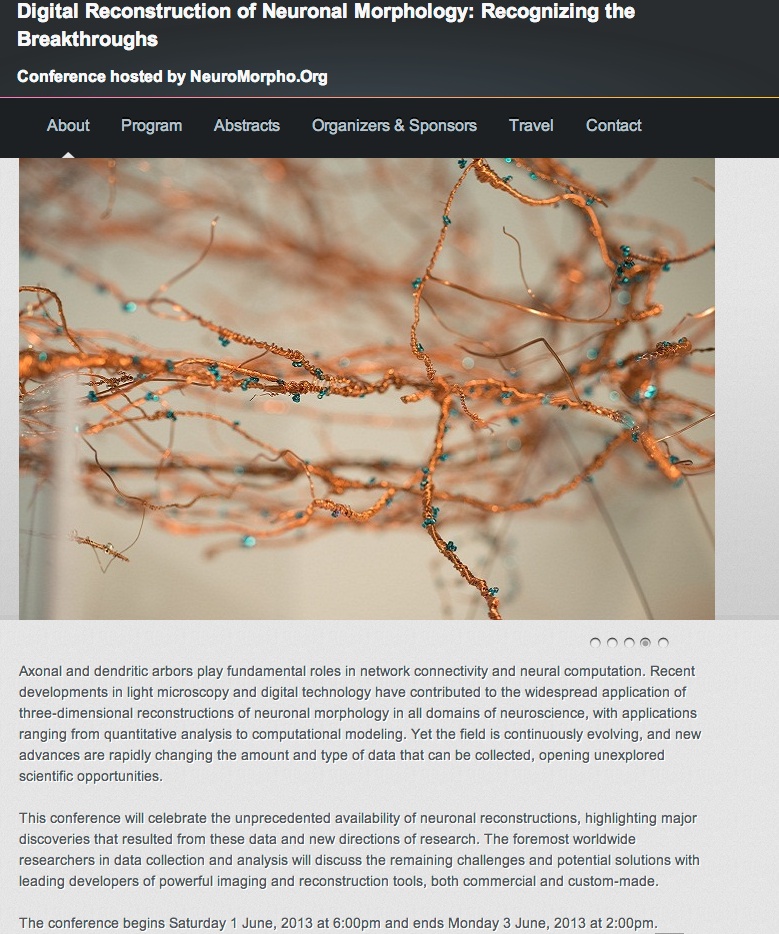 A terrific conference is winding up at the Krasnow Institute today, the web site is here. Organized by Krasnow’s own NeuroMorpho.org, under the visionary leadership of Giorgio Ascoli, with the sponsorship of Burroughs Wellcome Fund USA and MBF Bioscience, the conference has brought together some of the best and the brightest in the field. To my mind, this is the single most important event for scientists working in this arena since the DIADEM challenge event of several years ago.
Small conferences like this one are a key example of what Krasnow does really well for the global advanced studies community. For readers who may have heard about the White House BRAIN project, or the Connectome, all of those initiatives depend of advances in automated digital reconstruction of neurons.
Krasnow’s own Hippocampome Project is an example of how this type of data can be mined and harvested to yield new neurobiological knowledge, in this case, about the brain region most clearly identified with learning and memory in mammals (such as us).
Some thoughts on E-Science
I’ve spent the last couple of days at an E-Science institute joining some of our university’s research librarians and meeting w. colleagues at places ranging from Harvard to UC Merced. I was excited to learn about how places like George Mason are moving rapidly towards providing comprehensive data-management solutions to PI’s in a way that both supports the requirements of funding agencies, but also allows for the reuse and sharing of data in new and innovative ways (like we do here at Krasnow, check out here).
I also learned about something called the Data Management Plan Tool (or DMP Tool) which can greatly facilitate developing these types of plans for grant applications to a variety of funding agencies (check that out here).
Finally, it was a lot of fun to do something entirely different from what I started off the week doing at NSF (see my earlier post on NBIC2). One of the best things about my job is learning about many different things. I still can’t get over how lucky I am…
View of a CA1 pyramidal apical dendrite from a deck at the Soma…

Yes, Tulip Poplar trees do have a strange resemblance to hippocampal neurons. This one, shot at night with an iPhone camera.
If you would like to learning more about neuronal morphology and how it affects function, go here.
Back to the grid
Later this afternoon, I’m headed back to DC from Wintergreen. It’s been an incredibly relaxing week (I finished Obama’s book “Dreams from my Father”) and greatly enjoyed the fact that Ken DeJong, our Associate Director, was running the Institute for Advanced Study with a fine steady hand.
I’m pleased to report that there were no bear sightings this time around, just lots of deer and of course the diversity of warblers that makes the Blue Ridge famous.
In the coming week, I’ll be thinking a lot about the Decade of the Mind initiative in the context of what’s now being called Science 2.0–analogous to Web 2.0. What might “mind sciences” accomplish through greater collaborations, better data-sharing and some powerful databases (like NeuroMorpho.org).
Jim
 Discoverers and Discoveries