The Larval Stage of Institutional Development

Krasnow’s larval stage was as a stand-alone institute constituted as a non-profit. It operated out of rental class-B commercial space in downtown Fairfax and had several employees (two of whom are still with us!). The Institute for Advanced Study had grand plans though–even at that time (nearly two decades ago), and moves were afoot for a meeting to be co-sponsored with the Santa Fe Institute which would focus our scientific program towards the intersection of neurobiology, cognitive psychology and computer sciences. There were also plans and money for a dedicated facility (albeit more like a think tank than a place with laboratories), and a seminar series was commenced that also, continues to this day. The initial aspirational models for the Institute were places like the Santa Fe Institute and to a lesser extent Cold Spring Harbor Lab, and Woods Hole. The notion is that we would always be stand-alone and that in a decade or so, there would be bricks and mortar, a powerful governance board that would provide the resources for an endowment and a cadre of scientists who would be principally identified as investigators rather than as academic faculty members.

The larval stage ended in 2002 with the merger with George Mason and the metamorphosis into the mature Krasnow Institute for Advanced Study as a full academic unit of the University. And yet, there are elements of the larval DNA that still remain: one of which is a commitment to the elite post-graduate educational programs offered by our early aspirational peers. While we have buttered our bread over the years since the merger with the development of doctoral programs in neuroscience and computational social sciences, this early notion of running summer short courses remains. The location of course is dramatic and special (the Institute is only 12 miles from the US Capitol Building). We now have superb conference and hotel facilities. And there is a critical mass of both faculty and related content/research that might be offered.

So we’re reactivating that latent part of Krasnow’s genome, left over from our larval era. In the meantime, we enjoy the massive advantages that come from being a part of a large, healthy public research university.

Thinking about the Two Cultures

I’ve been thinking a lot about C.P. Snow’s Two Cultures lately. Snow, in his seminal mid-twentieth century lecture (followed by an article and two books) put forward the notion of a dialectic between the social sciences and the hard sciences. One of his most famous quotes concerns querying some literary friends about the 2nd Law of Thermodynamics in response to their complaints about the general ignorance of scientists about literature. The upshot is that they didn’t know about entropy or the 2nd Law.

Here at Krasnow, we have, only in recent years, become a true locus for advanced studies as we added, first a center for social complexity and second a department of computational social sciences to our existing center of mass in neuroscience (writ large). These days research at Krasnow spans Snow’s two cultures pretty effectively, but largely without the communications divide postulated in Two Cultures.

Why is this?

For one thing, I think it’s a result of an unspoken norm at Krasnow to strive mightily away from the technical jargon of one’s field. For another, it’s the result of another de facto agreement to actually communicate intellectually outside one’s comfort zone. Taken together, the result is what has been called a “third culture”. From my own perspective as Institute director, this third culture is one where intellectuals actively appreciate the connection between human creative and artistic expression and the neural activity of brains that produce those expressions. Hence high culture becomes an emergent of interacting human minds, rather than a no-go zone for those well-steeped in the hard disciplines. At the same time, intellectuals in the social sciences are willing to explore and leverage the tools of hard science (especially computation and complexity theory).

Mobilizing for Phase II

Today, the mobilization began for the next phase in the facility that houses the Krasnow Institute for Advanced Study. Over the next 12 months we’ll be adding approximately 15,000 new square feet of wet labs, core facilities and offices to bring the Institute’s main facility up to about 60,000 square feet.

With our outstanding faculty, programs and staff, we’re well on our way to reifying the vision of our scientific founders.
In the meantime, I’m already thinking about Phase III on the other end of the Institute, to bring our Center for Social Complexity and Department of Computational Social Sciences all under this one roof.
Cheers,
Jim

Spring semester

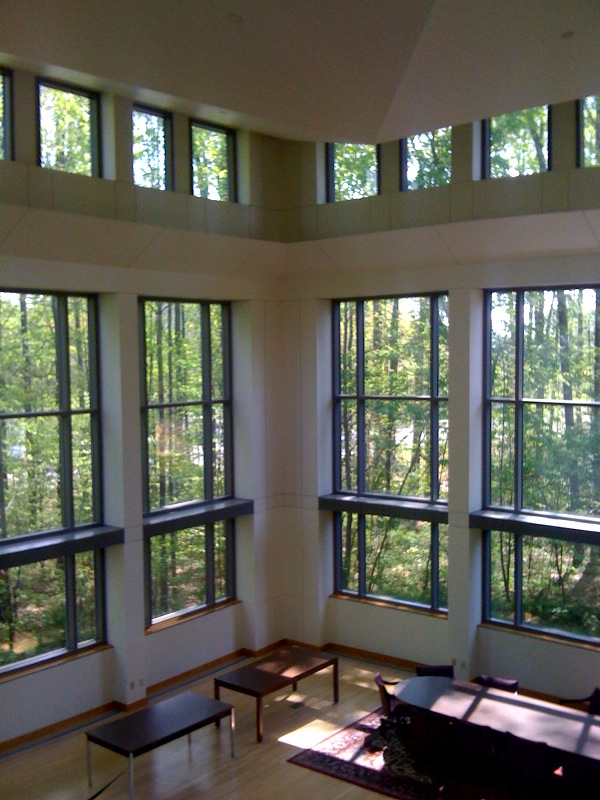
As we enter the latter part of the Spring Semester, the view from the windows of Krasnow’s Great Room gets greener. Only eight weeks ago, the view outside was arctic-like, with mounds of snow that looked to be permanent.

This has been an excellent year so far for our science. Most exciting has been the proliferation of large-scale grant awards that bring together many of the disparate disciplines represented at Mason’s Institute for Advanced Study.
It’s also been gratifying to open Krasnow’s new cellular imaging facility and to welcome two new functional brain imagers to our faculty.

Cellular imaging at Krasnow


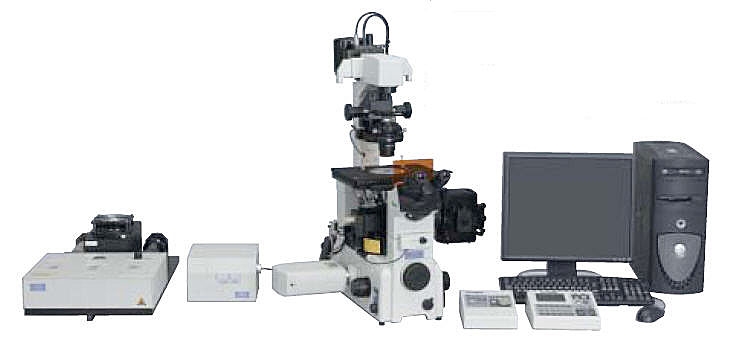
I’m pleased to report that we’ve taken delivery of our Nikon C1 confocal microscope and that very shortly we’ll be opening a cellular imaging core at the Institute to complement our MRI facility.

So what’s the deal with confocal microscopy? The short version goes like this: biological specimens, especially living tissue ones, are thick. Classical microscopes have a problem with this and internal organelles get blurred out. With confocal microscopy, we can get around that problem and look into the sample with all the detail of the cell’s three-dimensional structure preserved. Used in consort with our ability to molecularly engineer biological components of the cell to fluoresce, this becomes an incredibly powerful tool for our neuroscientists who work at the neuronal or cellular level.

Half-way through the summer

A bit over a month from now, the University will begin gearing up for the Fall semester. It just seems like yesterday that the Spring semester drew to a close. Summer is short and sweet at the Krasnow Institute for Advanced Study.

As we pass the mid-point of summer, with many of our PI’s away on summer travel and research, I think it would be useful to preview some of what will await them and our students upon their return and the beginning of classes.
First, in late August, we’re opening up three brand-new labs in what’s currently called the new-wing of the Institute. One of those labs will embody the site of a new much closer collaboration between the Department of Neuroscience at Inova’s Fairfax Hospital and George Mason’s neuroscience research activities. The other two will be filled by Drs. Dan Cox and Nadine Kabbani. Dan works on drosophila neurobiology. Nadine is interested in the proteomics of dopamine and nicotinic receptor interactions within the central nervous system.
Second, probably in November we’ll commence construction of Phase II, or rather the “new” new wing of Krasnow, which will include eight new wet labs and associated support space, PI offices and a laboratory commons to complement the Great Room in the original building. That construction should be finished pretty much exactly a year from now so that we’ll take delivery of the new space in time for Fall of 2010. We’ll open up an intranet blog to post construction updates so that everyone at the Institute can coordinate their science. Hopefully the inconvenience will not be too great and what we gain will be both beautiful and functional.
Also, we’ve opened up a second “satellite” facility for Rob Axtell’s research in the new Volgenau Engineering Building. This space for agent-based modeling complements the existing Center for Social Complexity Space in the Research I building.
So the Institute continues to grow, even in these economically difficult times. That’s a tribute to the science that our faculty do.
Jim

Another academic year

We are on the cusp of commencement here–it’s 12 days away–and yet another academic year is about to end. I did a walk through of the building with my associate director, Ken DeJong, this morning and was astounded to see some of the places that I rarely frequent. There was a time when I knew where everything was–we’re too large for that now, so there are funny surprises for me, as well as our students and faculty who have been here for less time.

On thinking back, this has been a fine year for Mason’s Institute for Advanced Study, in spite of the much vaunted Great Recession. I continue to be impressed by our incredibly bright trainees, our productive faculty and the general willingness of all to reach out across their disciplinary boundaries to new colleagues, all while maintaining a vibrant collegiality.
That and the extant willingness to take on scientific risk, makes this a dream job.
This weekend, I went to the ballpark and watched as the hapless Nationals easily disposed of the St. Louis Cardinals. It seemed an apt metaphor for those of us living here, in proximity to Jefferson’s and Lincoln’s monuments: in the worst of times come the most pleasant of surprises.
Greenshoots,
Jim

DIADEM Challenge

The Krasnow Institute, HHMI and the Allen Institute for Brain Science announced a grand challenge project today–to create better tools for image analysis.

Money quote:

The organizers hope the DIADEM Challenge—short for Digital Reconstruction of Axonal and Dendritic Morphology—will lead to innovative solutions to a frustrating problem that has slowed efforts to create a functional atlas of the brain. Neuroscientists agree that a systematic characterization of neurons with their dendrites and axons is essential, since these tree-like structures are highly correlated with the electric activity of, and precise connections between, neurons and are thus linked to the functions of specific brain circuits. But scientists currently spend weeks—and, in some cases, months—tracing the intricate neuronal processes by hand, using data supplied by imaging studies.

Jim

Krasnow Friendraiser 2009: Wizards vs Pistons


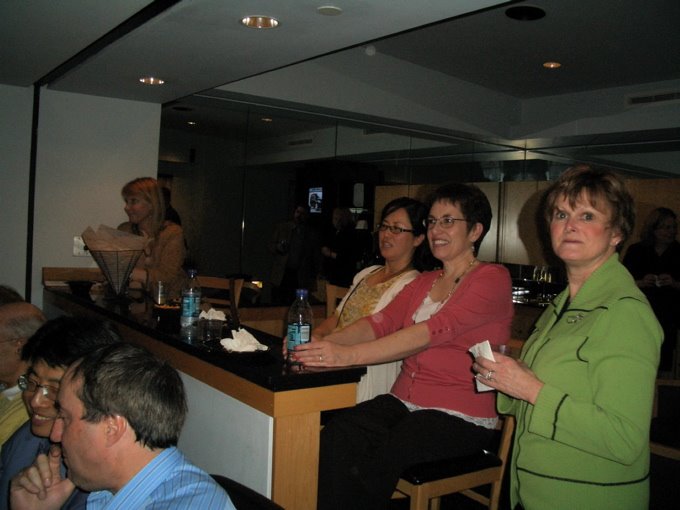
For the third year running the Institute for Advanced Study hosted a friend-raiser at the Verizon Center as the Wizards gave the Detroit Pistons a run for their money. We had a mix of scientists, board members, friends and staff for a heady mix of basketball, cognitive sciences and keeping track of our NCAA brackets.

This year we were honored to also enjoy the company of former Congressman Tom Davis, pictured above with a young fan.

Running an Institute during an Economic Downturn

While the current Recession isn’t the first downturn I’ve lead the Institute through, it’s by far the worst. The combination of cascading negative external factors combined with the uncertainties have created a unique set of challenges. On the other hand, this time around, the Institute is well situated in terms of a scientific critical mass, an excellent sponsored research portfolio and the massive (and still growing) infrastructure of George Mason, Virginia’s public Carnegie Research university in the National Capital Area.

Given the times, and the fact that I’ve been director long enough to have seen downturns before, I thought that it might be useful to put down some of the principles that I am using to get us through the current difficult conditions:

1) Budgeting–prioritize to protect the core scientific/academic mission, realizing that with those two intact, all else can be quickly regenerated.

2) Transparency–keep all stakeholders up to date on exactly what is happening, what the current plan is, and where the uncertainties lie. Do this continuously in multiple contexts throughout the crisis. The result is to strengthen morale and to mitigate distracting what-if scenarios that can damage the scientific/academic programs.

3) Maintain a position that will allow for rapid transformation back into growth. While recessions are macro-economic events that affect scientific institutions, the nature of science funding is such that a massive downturn might happen in tandem with significant increases in federal science investment. It’s important to keep that in mind so that the institution is prepared to opportunistically emerge from hunkering down to compete and win new awards.

4) Protect support staff–those who have invested years to support the science of the institution may not be the feed grain, but they are surely the farmers, who through their experience, can both see us through the difficult times and make possible the conditions for scientific success in the future.

5) Fundraising–realize that the continued engagement with those who have given personally to the institution in the past, but may not be able to under the current circumstances, is central to the building of long-term loyalty so central to leadership level gift opportunities.

Jim