From today’s NYT, here. We have a long way to go in neuroscience.
Author: jlolds
Viral Spillover: predictable?
The New Yorker routinely does an excellent job with science. This piece by Matthew Hutson is another good one. The debate is whether it’s worthwhile even trying to scientifically sample the animal reservoirs (e.g. bats) where this zoonotic transfer begins. Is it hopelessly complex? Is the sampling itself playing with fire?
My own sense (based on my NSF experience) is that there are valuable rule sets that can be revealed and these are what we must try to figure out. Yes, the complexity is high–the interactions span genomes to ecosystems, but the payoff could be immense. Early on in the pandemic, I blogged about a hypothetical COVID30. Because of climate change, we may be facing new infectious disease assaults on humans much more frequently than that as animal reservoir species and humans migrate towards intersections in space and time.
How will we use our quantum computers?
One of my colleagues asked me the other day what I thought the opportunities were for using quantum computing in the biomedical application space. My answer was pretty skeptical. It’s easy to see how AI has paid off for life sciences. Not so on how quantum computing will make a big difference. I’d love to be wrong though. Could quantum computing allow us to predict the trajectory of a viral phenotype accurately? Could we automate rational small-molecule design? How will we use our quantum computers?
Is Sponsored Research a Loss Leader….
The question I’m asking is whether universities and academic medical centers actually make money on federally-funded sponsored research through the recovery of indirect costs. It’s a fair question: indirect cost rates vary greatly by institution. They are nominally paid by the US government to allow institutions to recover the costs of keeping the laboratory space functioning as a venue for conducting experiments. The indirect cost rate for a given institution is the product of a bi-lateral negotiation between government and the university guided by a formula which takes various factors into account. Is there arbitrage going on? I don’t know. But I do know that various administrators that I’ve talked to across the country have described the entire enterprise as a loss leader for universities. That is: their story to me is that they are actually loosing money on their research activities. And…I can see why a school would do that. Research success is very prestigious and can attract other revenue-creating activities such as students paying tuition. But it also seems that, because of the one-on-one nature of the negotiation for each institution, the balance could be the other way: institutions could be making a profit on research. It would be useful to see the hard data for this.
…just asking for a friend (smile)
Woods Hole and doing science…

There is a kind of science that takes place during the summer in Woods Hole that follows a unique process: two scientists (they can be at any level of seniority–one might be a senior professor, the other a grad student for example) sit down by the water over lunch and compare experimental results. Together they notice someone odd and unexpected in some recent data. They wonder if the oddness might be explained by some ‘totally out there’ explanation. They design a new experiment to test their hypothesis. That evening, they set up the experiment and around 2AM the next day, they both witness the result which changes our understanding of biology.
The bringing together of life scientists to randomly interact like that and then, productively, move our field forward of course happens elsewhere. But I’ve never seen it happen more regularly than at MBL. There is a magic to the place that is beyond the beauty of an Eel Pond sunrise. As with evolution itself, both history and contingency play an important role in Woods Hole’s secret sauce. I’m not at all sure that it can be scaled. But it’s an important example of how science can be a successful enterprise.
The use of machine learning to understand emergents of ecological networks…
Evan Frick’s paper in this week’s science, here. What’s really interesting to me is not so much the result (which isn’t really surprising: that terrestrial mammal food webs have been collapsing) but the use of AI to address the complexity of how the ‘phenotype’ of the biosphere changes over time.
Center for Biomedical Science and Policy
Our newly minted center at George Mason’s Schar School, here. With my co-director, Naoru Koizumi, we are building a new nexus between the clinic, the bench and policy makers.
One of my favorite places….
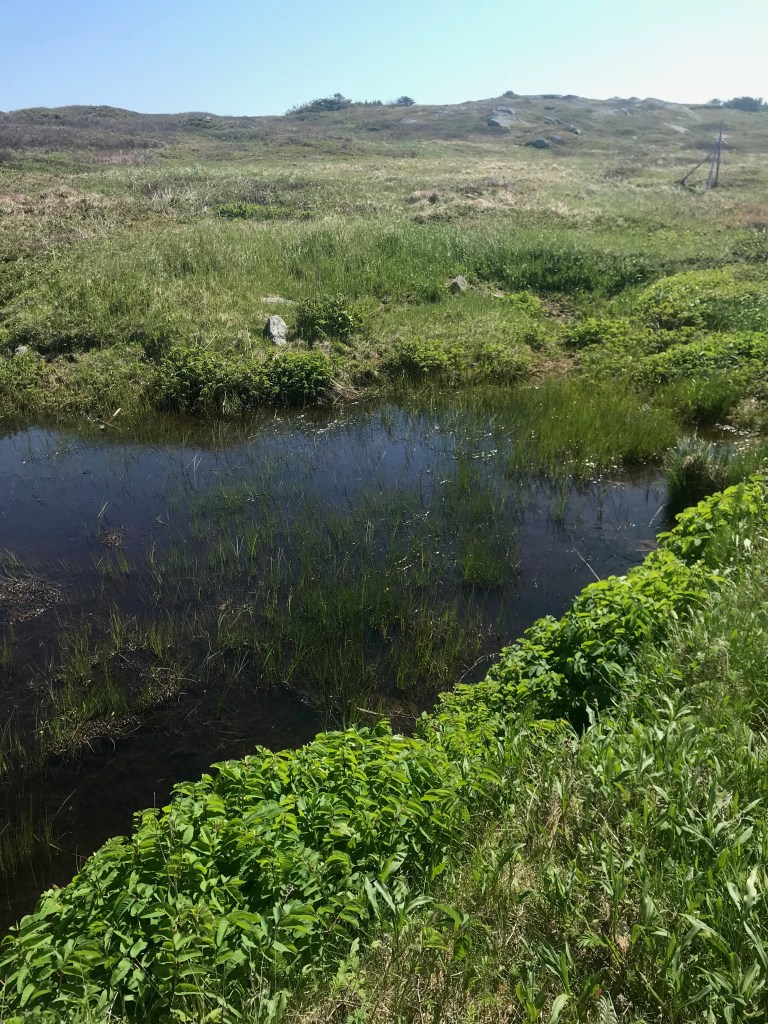
Fogo Island, here. Atlantic Canada is under-appreciated.
Terraforming Mars for less…
Loyal readers know that I am fascinated with the red planet. Hat tip to Tyler on this blogpost from Casey Handmer. Casey worked at Hyperloop and NASA’s Jet Propulsion Laboratory before founding his own company. A Caltech PhD, he knows his stuff.
Open-access on steroids…
The story from SCIENCE, is here. The upshot is that journal articles that result from US-funded research have to be made available for free to the public as soon as published. No more year-long paywall. The idea, is that the taxpayer already paid for the work once and that having to pay again for access is double-billing. Apparently this also goes for the data. I’m for this, but how this will actually be implemented isn’t clear. Someone has to pay for the editorial labor. Will the publishing fees now be written into a grant proposal budget as allowable direct costs? A lot of business models are going to have to change I think.
One caveat: all of this is reversible by a successor Administration.