HHMI’s President Robert Tjian on supporting life science in these times…

His open letter is here. I think Peter Thiel would be glad to see HHMI out there supporting life sciences…even as things get difficult.

Tjian makes the point that HHMI has agility and independence going for it. To that I would also add they also have a very strong dose of meritocracy.

Supporting the very best scientists is the key thing. Note how different that is from trying to forecast programmatic scientific success.

Francis Fukuyama interviews Peter Thiel

In The American Interest, here. One of the best long-form journalism pieces I’ve read in a very long time. It touches on so many of the significant issues of our time (from neurobiology to energy policy) that it’s very difficult to blog about–Advanced Studies tends towards short-form pieces.

Ultimately, it’s a conversation between two extraordinarily bright people about where America is, one decade into the 21st century. You may not agree with either of them on much, but the issues discussed are central to our current problems.

So do read it.

NYT on Big Data

In today’s Review section, here.

Shout out to Mason’s own Rebecca Goldin in the piece:

Big Data has its perils, to be sure. With huge data sets and fine-grained measurement, statisticians and computer scientists note, there is increased risk of “false discoveries.” The trouble with seeking a meaningful needle in massive haystacks of data, says Trevor Hastie, a statistics professor at Stanford, is that “many bits of straw look like needles.”
Big Data also supplies more raw material for statistical shenanigans and biased fact-finding excursions. It offers a high-tech twist on an old trick: I know the facts, now let’s find ’em. That is, says Rebecca Goldin, a mathematician at George Mason University, “one of the most pernicious uses of data.”

The Science of Complexity: Understanding the Global Financial Crisis


The Science of Complexity: 
Understanding the Global Financial Crisis
Co-sponsored by Santa Fe Institute and the Krasnow Institute for Advanced Study at George Mason University
May 16-18, 2012, at the new Founders Hall facility at the GMU Arlington, VA campus.


The time-honored formulas of mainstream economics no longer capture the complex dynamics of today’s financial markets. This three-day symposium offers a view of the recent global financial crises from a new perspective—that of complexity science.  Sponsored by two leading complexity research institutes, the symposium will feature several of the world’s most prominent complex systems thinkers.  These experts will offer insights from non-linear dynamics, social networks, systemic risk, experimental economics, self-organized criticality, computational social science, and other areas that are vital not only to understand the current crises but to develop policies that address the underlying causes.   


The program is open to any interested participants, but is particularly designed for professionals in government, business, and the non-profit sectors.

For more information see http://krasnow.gmu.edu/soc Register now.

Encouraging collaboration…

At our Institute, a major “price of admission” for new faculty is a willingness to collaborate across disciplinary boundaries–the notion being that the loci for many major advances lie at the boundaries of disperate fields. This in itself is challenging because different disciplines operate with different technical languages, commonly called “jargon”. Finding a lingua franca between different disciplines takes time and energy and the pay off, while potentially large, is always fraught with risk (true scientific research is always risky).

Hence, here at Krasnow, the challenge is to encourage such collaboration across disciplinary boundaries, but the even deeper challenge is to encourage collaborations in general. Why?

A major reason is that our current training in science, especially at the doctoral level, emphasizes a solitary rather than team approach. The PhD thesis is, after all, a singularly individual intellectual product–the doctoral advisor’s name doesn’t go on the title page as an author for a reason. While the acquisition of data used in a dissertation may in some cases involve a team approach (think big data physics), at the data analysis level, for the thesis, the work is generally that of the graduate student.

Another reason for the challenge in getting scientists to collaborate is the inherent difficulties, under current systems of sharing data. Until data sharing curation and provenance norms are universal, the “safe” approach is to keep one’s own experimental data under wraps. While large scale data sharing is a desirable end-point, we still aren’t there yet.

Finally, my own sense is that a key ingredient of scientific success involves the ability to think intensely, without distraction, about a problem–and most individuals find it easiest to do this alone. Even if this isn’t the case, the conventional wisdom is that the “ah ha” moment follows such a period of introspective pondering.

So those are some reasons….how might one still encourage collaborations?

Lexington on Charles Murray’s new book

The Economist’s Lexington columnist weighs in succinctly on Murray’s new book here.

Money quote:

Your own columnist, a jaundiced Brit residing temporarily in a SuperZip, wonders how the lower class will respond to hearing that the main help it needs is an infusion of its betters’ morals. Mr Murray believes his numbers show that following his prescription can help people lead fuller lives at almost any level of income. He may be right. But those in the upper class who heed his call might want to leave their Mercedes Benzes at home when they set out for Denny’s and their voyage of persuasion.

Science Investments…

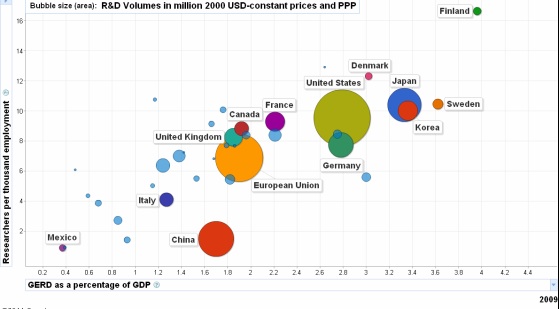
They are something we do here at the Institute level when we buy a new piece of shared equipment, but they are also something a nation does when it sponsors R&D through agency grants programs or through national laboratories.  The below graph (full movie presentation go here) shows 2009 OECD data for researchers per 1000 employees (y-axis) versus National R&D as a percentage of GDP (x-axis). The bubble size adds a third dimension: non-normalized national R&D. What jumps out pretty clearly is that Finland is investing in science at a very high level. And, that the US, if one normalizes by either population or GDP isn’t the leader.

Although the public often sees these investments through the lens of the deficit, the larger context is a nation’s ability to grow its way out of its fiscal problems as opposed to deflation and massive deleveraging. Science investments create the “garden” environment for the next wave of technology revolutions that Tyler Cowen talks about in his recent book, The Great Stagnation.

How is science investment paying off for Finland? Having recently returned from Helsinki, I can report first hand evidence of a vibrant technology start-up community, perhaps Europe’s most healthy economy, and a K-20 education system that is a world-leader. To me those are side-payoffs from the science investment. And they are very important.

However the central payoff from national science investment is the increased probability of a “game changer” discovery that leads to a revolution on the scale of the Industrial Revolution. Because science is serendipitous as far fundamental discoveries are concerned, we can’t forecast them with any accuracy. What we can do is invest as much as possible so that the probabilities of great discoveries go up.