

Bruce Scheier’s excellent and timely essay is here. Excellent because he really nails the problem that our human cognitive capabilities are not particularly up to accessing the probability of Black Swan events, and timely because of the impending anniversary of events that played out here and in New York twelve years ago.
Author: jlolds
Native Angeleno, professor of Neuroscience and Public Policy at George Mason University
NeuroX redux in the New Yorker….
Adam Gopnik on the NeuroX wars in the New Yorker, here. Money quote:
Philosophy may someday dissolve into psychology and psychology into neurology, but since the lesson of neuro is that thoughts change brains as much as brains thoughts, the reduction may not reduce much that matters.
From today’s Guardian: Looks like a sagittal section of a mouse brain?
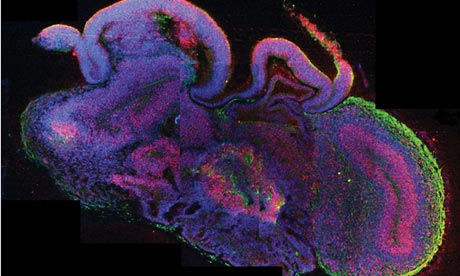 |
| Stem cell scientists at Edinburgh and the Institute of Molecular Biotechnology in Vienna grew this organoid, or tiny ‘brain’, which measures just 4mm across. Photograph: Madeline A Lancaster/PA |
The Guardian story is here. The original paper was just published in Nature and…like the NYT… it’s not available right now, odd target for a denial of service attack, but there you go.
Non-discretionary personal spending…
Apparently we’re just like the federal government, our personal budgets are being squeezed by what amounts to non-discretionary outlays: health care and education. Patrick Appel in Andrew Sullivan’s Dish, here.
My own analogy with the non-discretionary side of the federal budget stems from two facts: health care is central to both and the mandatory expenditure nature squeezes cuts onto what’s left. In the case of the feds that includes R&D (like NIH and NSF). In the case of Mom and Pop, probably they are doing less retail shopping…and in fact that fits the latest data.
Public Intellectuals….
Carnegie Mellon’s Jeffrey Williams has an excellent piece on public intellectuals and Stefan Collini in particular, here. The context is the current higher education debate in the UK (also taking place here in the States).
The money quote:
It was a historically unique situation, he noted: “I’m lucky in my generation. If I had been born 15 or 20 years earlier, from my social background I certainly wouldn’t have had most of the opportunities that I have had.” And, given the cuts enacted in the Thatcher era, “if I’d been born 15 or 20 years later, certainly in Britain, I think the road would have been much rockier in the lack of jobs and declining working conditions in universities.”
Seniors (not the 22 year old kind) and academic tenure…
From George Mason’s provost, Peter Stearns, here. His points on academic freedom are well taken. I also salute his concerns about productivity and salary distortions.
Now let’s look at the data:
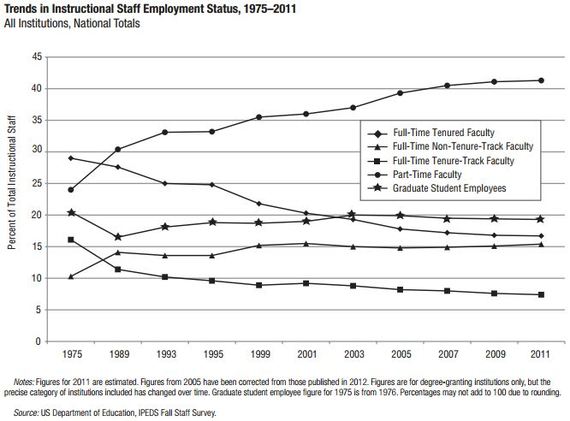
De facto, tenure may be going the way of the dinosaurs. Specifically, institutions are using non-tenured faculty to handle increasing amounts of the teaching load. In fact, I would argue that as tenure faculty retire, they are being replaced by adjuncts or contract faculty members.
Where does this all lead?
The data show here suggest a low asymptote, where tenure is part of the compensation package for superstars while the bulk of the teaching will be increasingly handled by others.
Michael Graziano on consciousness…..
The Princeton University neuroscientist on his theory of consciousness here. Consciousness remains a central question for our faculty here at the Krasnow Institute, even as our research covers the entire waterfront of cognition related phenomena.
Thoughts on the Obama higher ed plan
First, I’ve never been impressed with government ability to pick winners and losers (NIH and NSF are such successful agencies precisely because they emphasize peer review). Second, as Tyler Cowen pointed out, there will be colleges that game the system–just as they do with the US News ratings today. Third, in my opinion, the underlying problem is the macro-withdrawal of state support for the public institutions that used to be the core of affordable higher ed. This withdrawal is what has generated the large increases in tuition–this contrary to much of the conventional wisdom on this issue. The Obama higher ed plan without any substantive change in state support creates a zero-sum game for the colleges, but it’s not going to be able to magically solve the problem.
Finally, I can’t conceive that this plan will be able to make its way through the paralyzed Congress–at least now.
So I’m skeptical.
Stay tuned….
 Discoverers and Discoveries