The next generation of space engines….

The story is here and it’s actually quite exciting. The key is VASMIR. Money quote:

Engine work has been underway for more than 25 years, and is based on NASA and U.S. Department of Energy research and development in plasma physics and space propulsion technology. Commercializing the VASIMR electric propulsion engine is the flagship project of Ad Astra, which has been in business for nine years and has invested $30 million to date to mature the concept. [Superfast Propulsion Concepts (Images)]

The driver for this engine is electric power which could be generated either by solar or a nuclear reactor. First practical application may well be the periodic boosts of the International Space Station required to maintain its low-earth orbit.
A cautionary tale out of Georgia Tech….

From yesterday’s NYT, here. Money quote:

But on May 17, 2010, agents from the Georgia Bureau of Investigation, wearing bulletproof vests, raided his university offices. A parallel scene played out at Dr. Laskar’s home, where his wife, Devi Laskar, found armed agents in her driveway. While agents went through the house and confiscated files and computer equipment, she went to a coffee shop to call a lawyer.

An excellent article on Joy Laskar, former professor and entrepreneur. And the strange tripping hazard that ended his career at Georgia Tech…

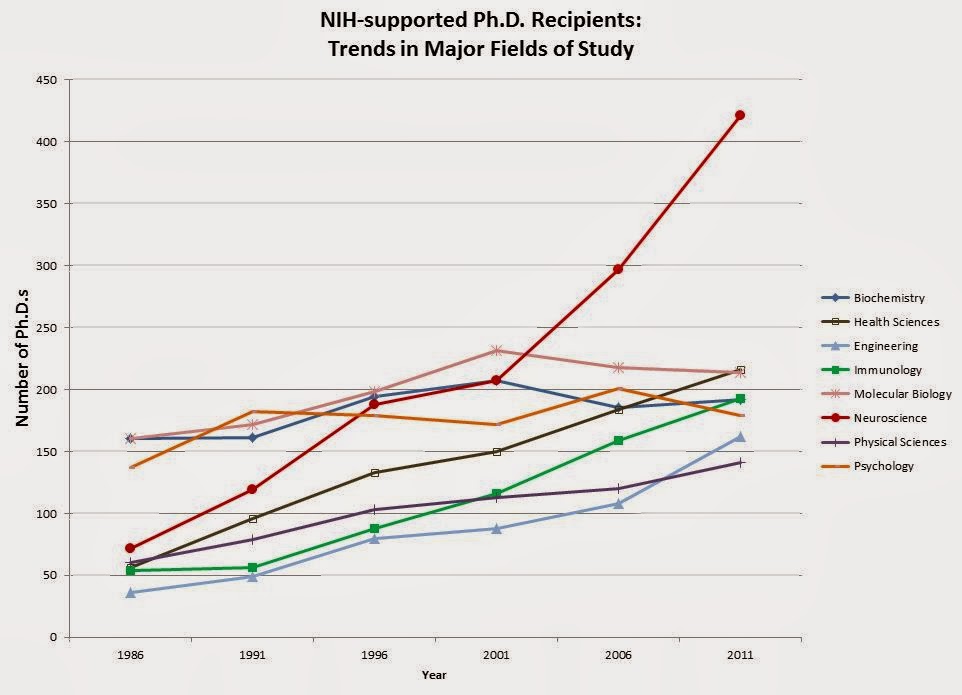
Neuroscience PhD trends swamp out other life sciences disciplines….

These data were just released by NIH. This is not surprising to me, you can’t be in the field and not take notice of what’s happening around you. The size of the trend however is what’s really interesting. One thought I had is that a neuroscience doctorate really provides potentially two hot career directions: one in brain diseases, the other in brain applications (which range from brain machine interfaces to neural-inspired computing).  So graduate students in the neurosciences may be choosing the field because of a relative abundance of job possibilities.

Who should own the Moon?

From Air and Space Smithsonian, here. Money quote:

Earth’s scientists have studied the returned data and we’ve dreamed of returning to the Moon and to new places where humanity has never set foot.  Entrepreneurs and social engineers see a time in the near future when we will make that next step and they each hold somewhat different views — some want to develop and capitalize on their investment, some want to preserve and permit only limited access.

The article raises some very interesting points, ones that will have important implications for the future of space exploration into the future.

Is NIH moving to restrict RO1 demand?

The story is here. The basic idea as I see it is that NIH plans to save money by trying to eliminate non-competitive grant applications on the front-end. The key statistical finding is that there is apparently no correlation between a university’s number of NIH grant applications and its number of NIH awards.