Tracking investments in graduate education

During my time leading the Biological Sciences Directorate at NSF, I learned that the agency spends around a billion dollars a year on graduate education—the training that is required after the undergraduate degree to turn an aspiring scientist into a true discoverer. Of that money, roughly 15% is spent on NSF’s flagship graduate research fellowships—a fantastic program that’s been around since the 1950’s and has played a central role in the early careers of many of the US science superstars. These are folks who have gone on to win Nobel prizes and the like. Winning these fellowships involves an intense competition of ideas and is peer-reviewed by the science community. I’m pleased that NSF tracks the career trajectory of these trainees pretty carefully. There is hard evidence that the graduate research fellowship program works.

Another 5% of the total is spent on trainee grants—the current version of these are the National Research Traineeships. These are training awards that go to universities which then award the support to graduate students that they select. I was trained under such a program (although it was NIH funded) when I was at the University of Michigan training in neuroscience. These are excellent funding programs and once again those folks who are supported in this way are tracked pretty carefully (I still get contacted regularly by the NIH asking what I’m up to).

But the vast majority, 75%, of what the NSF invests in graduate education is untracked. These embedded in the dollars that go to research grants of scientists at US universities who then hire graduate student research assistants to actually do the work. We don’t know what happens to these trainees. There simply is no easy way at getting at the data.

In strikes me as unwise to make such a large investment without getting feedback on how things are going. In particular, I am concerned that those graduate students are being inadequately mentored in some pretty substantive ways. For example, I fear that they are too often treated as an extra pair of hands rather than a future professional colleague. Time spent teaching these students about career options or how to effectively teach undergraduate students is time away from the laboratory bench.

There are ways of tracking such students. One such mechanism is the orcid id system. There are others. If all students supported by the NSF were required to be registered in such a system, then it would be possible to track their career easily (as long as they stayed in science). But success on that front requires one other thing: that journal publishers and data repository sites require that a person’s id be attached as meta-data to every single piece of scientific data from the results of a single bench top experiment or a field observation all the way to a finished journal article.

This is not impossible. I think it is important to move this direction because it will allow for evidence based decisions about how to optimize NSF’s graduate student support in the future.

About that photo…

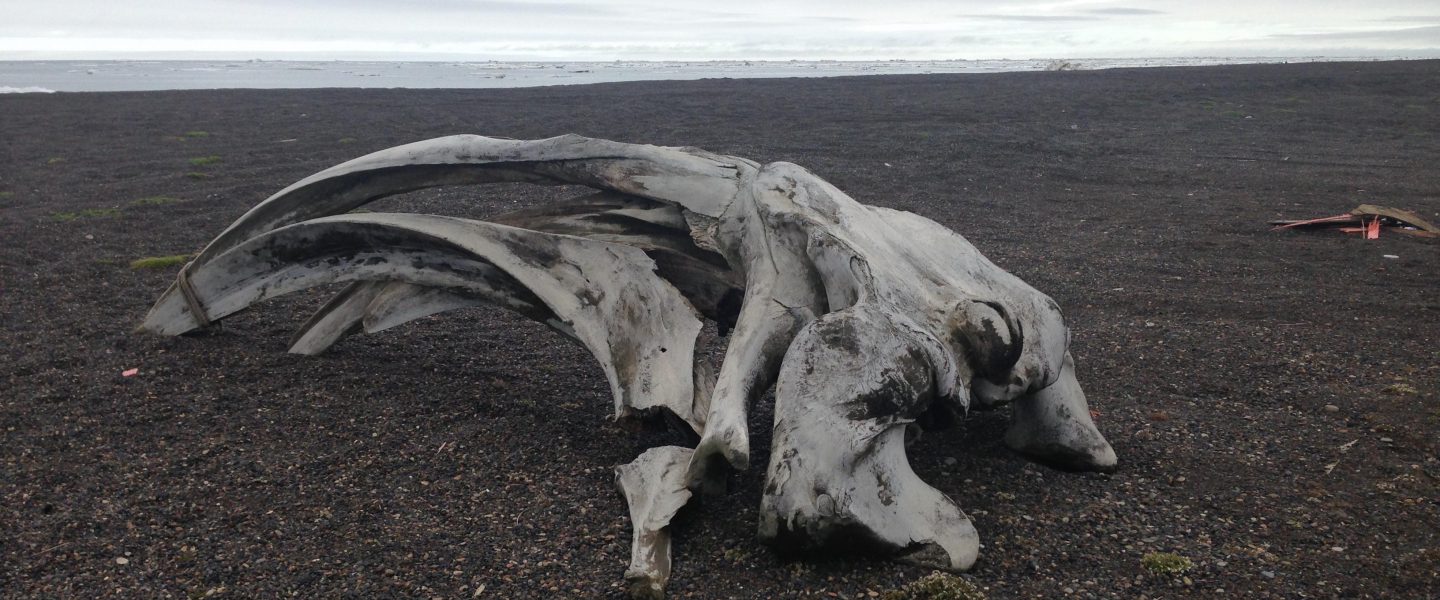
The one at the top of this page. I took that photo on the edge of the Arctic Ocean in Barrow Alaska. In the foreground is a whale skull. It’s a stark scene and in a sense a perfect visual metaphor for the uncertain times we live in. You’ll notice a complete absence of sea ice. With a good dry suit, I could have gone surfing. This was not always the case. While Climate.gov is still live, you can see quantitatively how drastically the environment has changed in Barrow here.

Much of the tundra in Alaska is permafrost. That includes communities such as Barrow. And that permafrost is now rapidly thawing. So Barrow’s future is quite uncertain. Look at my photo one more time. Real enough, right?

Jim Olds returns from NSF

I am back at George Mason University after 3 years of heading up the Biological Sciences Directorate at the U.S. National Science Foundation. For those of you who have not followed my career, this was after 16 years heading up the Krasnow Institute for Advanced Study at George Mason and Chairing the Molecular Neuroscience Department. These days find me at the Schar School of Public Policy and Government where I am University Professor of Neuroscience and Public Policy.


Making big changes can be difficult…even when you are in charge

One of the first things I learned, when I came to NSF, was how entrenched the status quo often is. A big project for the Directorate was headed for disaster and no one seemed to be able to pull the fire alarm. In the end, I needed to move the program, and change out every single individual from our management team before things began to turn around.

Now, I’m facing a similar challenge with another big ticket project. It’s been frozen in place, with ‘business as usual’ for years and there’s a lot of pressure from within to just keep on keeping on. Trouble is, it makes no sense in terms of the best interests of the rest of the Directorate. So, we are making changes, but once again very much sailing into a headwind. There are a lot of strong emotions directed at keeping things just the way they’ve always been.

But when you’re in charge, you actually are charged with making those big changes. Too stay in stasis is to fail.

It’s panel season here at NSF…

Which means the lobby and elevators are jammed first thing in the morning. But it also means that community members are coming together to perform the lynchpin function in the merit review process–in my opinion this peer review has been critical to the empirical success of the NSF since it’s founding in the early 1950’s.

Which brings me to the point of this blogpost: I think that where appropriate from the standpoint of expertise, more deans, provosts and even university presidents should participate in NSF panels. I think this would help them hone the qualities of “scientific taste” that they need for recruitment, retention and even promotion and tenure processes. I know, that during my sixteen year tenure in a decanal position at George Mason, serving on many NSF panels helped me a great deal in building out a high-performing faculty team at my academic unit. Of course, there will be conflicts of interest for proposals from one’s home institution and administrators would have to recuse themselves from those discussions and decisions.

After a year and a half at NSF

So, right now this blog is private because I’m very much in the public eye. But one day, when I return to academia, it’ll go public again. So I’ve decided to start writing again today.

Yes, running BIO at NSF is the most challenging job I’ve ever had in my life. I find myself working at, our beyond the level of intensity of my years in grad school in Ann Arbor. The high points are incredible. The low points are devastating. I certainly didn’t expect this type of life for my sixties.

Writing is like exercising. I’m out of practice. So it’ll be slow. But I’m ready to go ahead again.