What really dark skies are like

The sky was perfect for observing last night here in Wintergreen
Virginia. The comparison with the skies of Washington DC is
startling: instead of perhaps 20-40 stars visible (Washington) you
can see perhaps 6000 with the naked eye up here. Through my telescope
I got an incredible view of the Andromeda Galaxy: millions upon
millions of stars.

Tomorrow, Columbus Day, there are no classes for Mason's
students….but it's a regular work day for the administration. So be
it. I have a pile of work waiting for me when I get back.

Jim

A bit of amateur astronomy


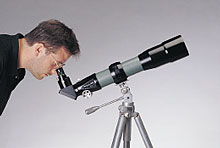
I’m in my Wintergreen house for the Columbus Day weekend. If I get lucky this evening, I’ll be able to do a bit of amateur astronomy with my TeleVue-85 refractor, a small jewel of an instrument which travels well and doesn’t require a lot of adjustments. That’s not me by the way, it’s from the advertising material. But my instrument looks just like that.

When we built this house, we put in a small observatory deck facing south, opposite the main view of the house which looks north up the Shenandoah Valley. With its height (above the trees) and southern view, this will be optimal for Fall and Winter observing.

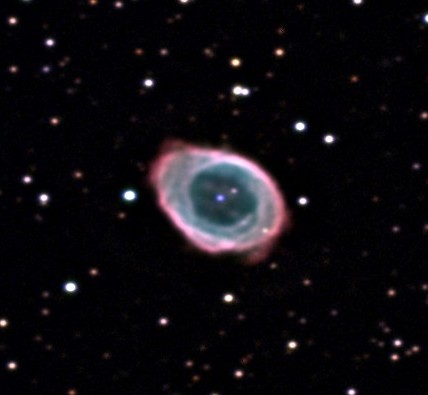
Tonight, if it stays clear, I’ll take a look at M57, the ring nebula in Lyra–one of my favorite sights.

Jim

Oprah’s Soul Series on XM -Radio

I’m getting a lot of requests for more information about the experience of being interviewed by Oprah yesterday evening for her Soul Series on XM-Radio. We did it out of the studios of WGMU in the Johnson Center here at Mason, but with the ISDN line it really felt as if the two of us were just having a friendly conversation in the same studio.

The first thing I need to say is that Oprah is an extremely personable interviewer. She put me pretty much instantly at ease with her combination of humor and warmness, and then we pretty much jumped into a discussion of just what modern neuroscience can offer us as to insight into the human mind, using Joel Achenbach’s article in the Washington Post as a starting point.

We talked about the difference between human intelligence and animal intelligence (we both came to the consensus that our dogs don’t spend a lot of time reflecting on either their soul or their place in the universe). I spent some time talking about what non-invasive brain imaging has gotten us….and what it hasn’t (i.e. we can’t read off the neural code).

Talking about meditation, I think she was surprised to learn that the Dalai Lama had been the star plenary guest at a recent Society for Neuroscience meeting held in Washington. Neuroscience certainly is interested in altered mental states.

The interview then turned to the “Decade of the Mind” project itself. My strong sense is that she understood why we belief that this proposed investment is necessary and supported it.

We also talked about my favorite brain structure, the hippocampus–how it is not only beautiful from a structural standpoint, but also what the clues from patients who have lesions to their hippocampi say about the laying down of episodic memories.

She asked me if it’s just a neuroscientist “thing” to find the hippocampus beautiful or would any person agree. Of course you can guess how I answered.

Finally I got to spend some time talking about the role of intuition in the life of an experimental science–how intuition at the laboratory bench can lead to that “Ah Ha” moment of discovery.

Jim

Strategic planning at universities

I’ve been through a few of them by now. Today’s Chronicle on-line has an interesting take on them that’s actually quite positive….

“To be useful, the plan must give an honest assessment of where an institution is and where it wants to go, planning experts say. It must also include specific, honest budget numbers.”

This is at odds with the camp that views “stretch goals” as the key method of strategic plans to take an institution up to the next level.

Jim

Managing the economic cycle

Here in Virginia, the business cycle has turned “south” again….it does this fairly regularly, this time the culprit is the sub-prime mortgage fall-out. In Michigan, this same financial stress, shut down the state government for several hours early this morning. Here in the Commonwealth, Governor Kaine announced a series of cuts and the use of “rainy-day” fund dollars to balance his budget.

For public universities, like Mason, these downturns are always challenging. For an institute for advanced study, where the revenue-side is more sponsored research (as opposed to tuition increases), this puts enormous pressure on the science faculty to succeed in what is clearly already a very tough federal funding environment.

For this reason, private sector gifts and grants are ever more important. As our Advisory Board comes together this month for its regular meeting, I’ll be asking them all to step up their level of support for the Krasnow Institute so that in these budget-cutting times, the science continues unabated.

Jim

Framing an argument

In my class yesterday we practiced framing a proposed scientific program within the constraints of a given Request for Applications from an agency. I think this is quite an important exercise for trainee scientists because success in grant writing depends on it. It’s not enough just to have great ideas and some great experiments planned to test those ideas. Additionally, one needs to develop the facility to take those ideas and plant them firmly in the context of a funder’s ideas and goals.

Jim

George Johnson of the NY Times on Algorithms

George, as you may recall, moderated the recent Decade of the Mind conference at Krasnow in May. Here is his take on where AI is these days: human brains mated with computer algorithms are powerful tools.

Money quote:

What is spreading through the Web is not exactly artificial intelligence. For all the research that has gone into cognitive and computer science, the brain’s most formidable algorithms — those used to recognize images or sounds or understand language — have eluded simulation. The alternative has been to incorporate people, with their special skills, as components of the Net.

Go to Google Image Labeler (images.google.com/imagelabeler) and you are randomly matched with another bored Web surfer — in Korea, maybe, or Omaha — who has agreed to play a game. Google shows you both a series of pictures peeled from the Web — the sun setting over the ocean or a comet streaking through space — and you earn points by typing as many descriptive words as you can. The results are stored and analyzed, and through this human-machine symbiosis, Google’s image-searching algorithms are incrementally refined.

Meanwhile from the Financial Times…

This is an article about the Mcgovern Institute up at MIT….and a proliferation of similar institutes funded by super-wealthy individuals. Money quote:

McGovern is not the only technology billionaire to dedicate a fortune to the brain. Paul Allen, the Microsoft co-founder, donated $100m to establish the Allen Institute for Brain Science in Seattle. And Jeff Hawkins used his fortune from Palm Computing, creator of the Palm Pilot, to set up the Redwood Neurosciences Institute at the University of California, Berkeley.

Jim

Igor Smirnov and Mind Control (Russian Style)

Here’s a really interesting piece from Cnet News about a rather strange Russian Institute that claims to “manipulate the subconscious minds” of terrorists.

Money quote:

SSRM Tek is presented to a subject as an innocent computer game that flashes subliminal images across the screen — like pictures of Osama bin Laden or the World Trade Center. The “player” — a traveler at an airport screening line, for example — presses a button in response to the images, without consciously registering what he or she is looking at. The terrorist’s response to the scrambled image involuntarily differs from the innocent person’s, according to the theory.