
Posted using ShareThis
Author: jlolds
Native Angeleno, professor of Neuroscience and Public Policy at George Mason University
Tyler Cowen on Blogging
Here’s Tyler Cowen on blogging and the state we’re in:
http://c.brightcove.com/services/viewer/federated_f8/1564494258
Tyler is a colleague at George Mason and head of the Mercatus Institute here. He’s also of course one of the co-authors of the blog, Marginal Revolution.
Jim
Memory molecules make the NY Times
The story of course is on Todd Sacktor and PKM zeta, a form of my own favorite molecule, protein kinase C.
Enjoy!
Jim
Tripping Hazards In Neuroethics: An Opinion
No doubt many readers are familiar with debates about the role of neuroscience in seeking to enhance (or augment) cognition, and possible policy implications, recently featured in Nature. Diverse contributions to science policy discussion help highlight important considerations for policy makers, including potential “tripping hazards” along the path to feasible policy, as illustrated in the recent commentary from Greely et al (2008). By “tripping hazards,” we mean papered-over or simply overlooked value fault-lines in policy formation that are likely to erupt in problems of feasibility or public acceptance. The authors’ recommendations about the use of cognitive enhancing drugs in healthy persons include concerns about safety, coercion, and fairness (meanwhile dismissing others as lacking substance). Their discussion of safety relies upon selectively stretching the idea of effectiveness and purpose for medication, while calling for safety standards to be held the same as for medicines treating illnesses. The “evidence-based evaluation” for which they call would thus be stretched over the values they’ve selected for inclusion and exclusion, and would be more likely to set up a “stretched line tripping hazard” for policy making than it would be to resolve controversy. The “thin ice tripping hazard,” on the other hand, emerges from their discussions of coercion and fairness, where the recommendations cannot support the weight of the problem. One sign of thin ice ahead is contradiction among recommendations, partially acknowledged but not here addressed, that we protect freedom by discouraging even indirect coercion to take enhancement drugs such as in schools, and protect fairness by providing them to all test-takers in a competitive examination. We commend the authors for contributing to the ongoing public debate but note that much remains to be done.
Jim Olds and Lee L. Zwanziger
Lee works at the FDA and therefore notes that the findings and conclusions in this letter have not been formally disseminated by the Food and Drug Administration and should not be construed to represent any Agency determination or policy.)
Greely H, Sahakian B, Harris J, Kessler RC, Gazzaniga M, Campbell P, Farah MJ.”Towards responsible use of cognitive-enhancing drugs by the healthy.” Nature. 2008 Dec 11;456(7223):702-5.
Why Kurzweil may be wrong
Aamodt and Wang, guest-blogging, at Olivia Judson see energy consumption as a fly-in-the-ointment for the Singularity.
I’m not so sure–depends on whether there is something similar to Moore’s Law that may be emerging for energy efficiency in computation–to whit, the new Intel Xeon 5500 chip.
Jim
Zeke goes to the White House
Zeke Emanuel and I went to Amherst College together. His brother Rahm is already pretty famous, but for those of us who spent the undergraduate years with Zeke–he was one scarily bright guy.
Enjoy this Chicago Tribune profile of the other Emanuel–probably the Nation’s premier bioethicist and possible future Nobel Laureate.
Hat tip to Tyler Cowen at Marginal Revolution.
Jim
Tom West’s new blog
I direct loyal readers to Tom West’s new blog. Tom has served on the Institute’s Advisory Board for many years and has a keen perspective about multiple ways that individuals think creatively.
Jim
Krasnow Friendraiser 2009: Wizards vs Pistons

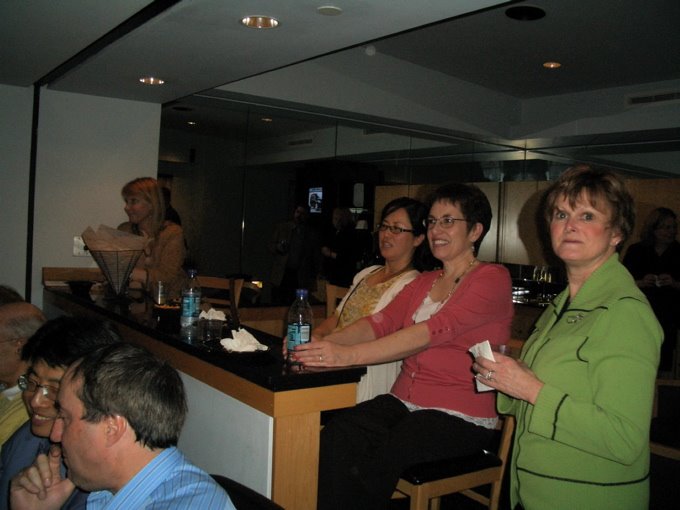
For the third year running the Institute for Advanced Study hosted a friend-raiser at the Verizon Center as the Wizards gave the Detroit Pistons a run for their money. We had a mix of scientists, board members, friends and staff for a heady mix of basketball, cognitive sciences and keeping track of our NCAA brackets.
This year we were honored to also enjoy the company of former Congressman Tom Davis, pictured above with a young fan.
Decade of the Mind V in Berlin
As loyal readers know, I’ve long advocated internationalizing the Decade of the Mind Project. I’m really pleased to report here that the web site for DOM-V in Berlin, Sept 10-12 of this year is up. This promises to be a spectacular meeting. Manfred Spitzer of the University of Ulm has been at the forefront of bringing this important goal to fruition.
Jim
Research for America
An unusual proposal for using the NIH stimulus money to avoid the boom-bust cycle from Sam Wang and Sandra Aamodt on Olivia Judson’s NYTimes blog–Research for America. Read all of it including the very active discussion.

