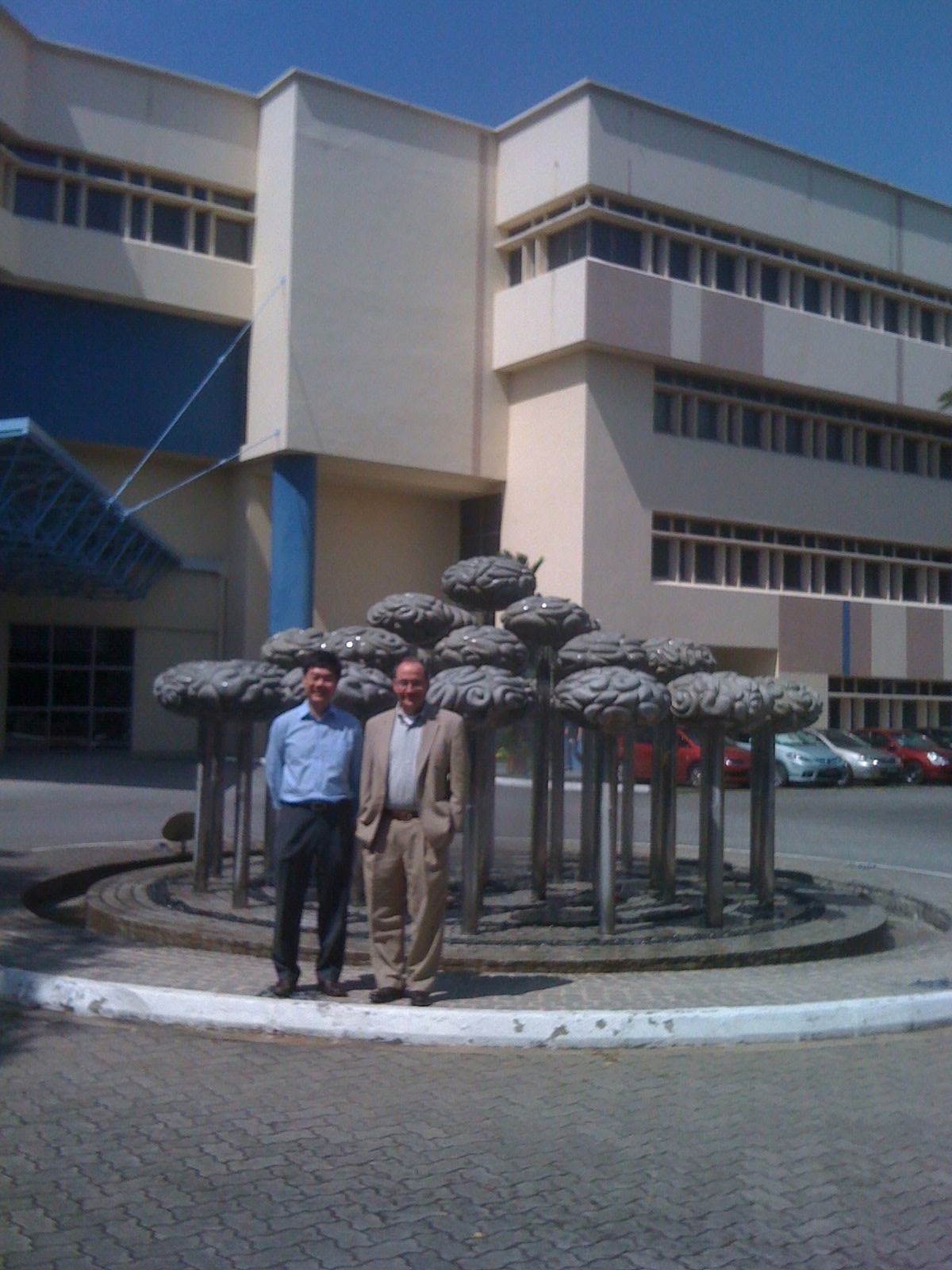
I’ll be off to Decade of the Mind 6, which is in Singapore on Tuesday. To get there I’ll be taking the longest non-stop route in the world, Singapore Airlines Flight 21 from Newark over the Pole, Russia, China and down into South East Asia. No time over the Pacific. I’ll try to get some good blog posts out from the meeting. My colleague Tyler Cowen, gave me special coaching in the foodie department, so I’ll be ready.
Author: jlolds
University of Michigan–where’s the recession?
I am in Ann Arbor for some meetings. It was gorgeous weather yesterday and the general well-being of both town and gown left me wondering where the Great Recession was. Now here’s the interesting piece of data: when I was going to graduate school here in during the heart of the 1980’s recession, I was completely unaware of what was going on with the rest of the national economy. This may be because I was too busy in the lab developing autoradiograms. But part of it, I suspect, was that Ann Arbor is in fact, strangely an island. On the way in from the airport, there were in fact many billboards offering help from foreclosure and the like. But the devastation seemed to stop at the city-line. Downtown having dinner at the West End Grill last evening, the streets seemed busy, shoppers seemed to be buying, the restaurant (in my opinion one of Ann Arbor’s best) was full.
So how does Ann Arbor manage this? Why does the U (as the University is often called here) appear to be in such rude health?
Final caution: I’m not so sanguine about the football team.
Old connected to the New
K-12 education
Gail Collins with her usual excellent NY Times column here. In the meantime, there are some very interesting new initiatives coming out of Mason that I hope soon to report to you on that have the potential to be transformative. Stay tuned.
Tenure at the modern research university
A loyal reader asks that I write about tenure. So some thoughts:
First, tenure is constantly evolving. The system that we have in the United States, created with the notion of protecting academic freedom, has become multi-threaded: the version at many academic medical centers (at large research universities with a medical school) has less to do with guaranteed salary and more to do with faculty prestige and rank. The version at large public research universities without medical schools is often backed by the tuition of students and carries with it, an implied teaching load with the potential for “course buy-downs” from research grants (although almost never to zero). At liberal arts colleges we find that tenure often brings the promise of salary growth (albeit slow and often non-meritocratic), substantial course loads and an explicit obligation to play a personal role in undergraduate education above and beyond the classroom.
Tenure in some countries in Western Europe resides nationally and can involve being assigned to a university in a potentially inconvenient town or city.
Finally tenure in some places is being rolled back to things like rolling 5 year contracts, with the general expectation of renewal, but no guarantee.
But the function of tenure, from my viewpoint, is now much more connected to the ability of institutions to retain talent and reward merit, than the original intent of protecting academic freedom–at least here in the States. That is not to say that tenure isn’t still invoked to protect the free expression of scholarship in the academy–it’s simply to recognize the reality that those occasions are quite rare.
One of the most interesting aspects of tenure is that it seems to be transferable within academia. This isn’t explicit, but by and large, having earned tenure at one institution of higher education, subsequent employment at a new school usually carries the old tenure decision forward (perhaps with promotion). This is both an aspect of a competitive market (it would be difficult to recruit a tenured faculty member without the promise of keeping their tenure at the new place) and the notion of tenure as an earned academic badge of merit (as for example the doctoral degree is also a badge).
By and large, I think tenure is a good thing. It allows an institute like Krasnow–which is able to grant tenure within George Mason University–to have a competitive edge against elite stand-alone centers which may not. But it is essential to keep in mind that tenure is not a license to dial back and become the proverbial dead wood.
Tyler Cowen’s view of the medium-term future for the US
Is here. He heads towards Kurzweil I think with this:
People will write profound books and papers on how and why “status quo bias” has strengthened, and then one day some new technological development will change everything.
Read the whole blog entry, it’s really good. I sure hope he’s right about his version of “The Singularity“, because otherwise, I’m afraid climate change or nuclear war will bite us badly enough to rule out a technological fix.
Ultimatum game players are tougher when they go green
Hat tip to Andrew Sullivan here. The Ultimatum game is well known to neuroimagers, especially those focusing on neuroeconomics. Here’s a bleg for the original citation.
Mount Holyoke College has a new President

Yesterday I had the honor of representing George Mason University for the inauguration of Lynn Pasquerella as its 18th President. I have family roots in the Nation’s oldest women’s institution of higher education (1837) and it the pageantry was wonderful. But more stirring was Dr. Pasquerella’s speech which eloquently called for global social justice for women–and for MHC’s alumnae to lead that effort.
As an aside, the Fall Colors are just starting to burst forth in the Pioneer Valley. New England is just weeks away from its annual spectacular show of autumnal brilliance.
NIH Reorg in the Works?
Science Insider says maybe yes here. As an NIH alum, I’m pretty skeptical that it will ever happen. But if NIDA and NIAAA ever did merge, then I think Nora Volkow should be the director of the merged institutes.
Anthony Gottlieb on the limitations of Science
A fine short essay from the Blog More Intelligent Life can be found here. Anthony is the former Executive Editor of The Economist.
His central point, which is well-taken, is that while the scientific method may be flawed, it’s the only game in town….Somewhat in the spirit of Winston’s Churchill’s view of democracy.
I would only add, that issue of publishing negative results he raises is somewhat overblown. Negative results that are truly paradigm-breaking, are newsworthy, and hence will find a scientific (and usually public) audience. So for example the famed 1919 test of Einstein’s theory, not withstanding Einstein’s famous quote, would have definitely have been published even if the result had been negative.