
The Vietnam era sent some of America’s best young scientists to Canada. It’s happening again.
Kyoto, Japan, 2016. There was a break between sessions, and I was out on the patio of the conference center venue talking with the President of York University in Ontario. We were both at the STS forum, one of the premier global science policy events, held each October in Japan.
“You know, most of my most senior neuroscience faculty immigrated from the United States,” he said.
I was pretty skeptical. With brain science powerhouses like Toronto, McGill, and the University of British Columbia, that didn’t make sense.
“Surely, that’s not the case,” I responded. “Canada is historically a leader in brain research. Look at McGill, alone.”
“I’m not talking about all my faculty,” he responded. “Just the most senior ones. They came over during Vietnam to avoid the draft.”
That conversation was ten years ago. Now it’s resurfaced in my memory for obvious reasons. Every time I visit an embassy here in D.C., the question comes up about my views on who should be on a list of up-and-coming young American neuroscientists open to emigrating.
I was a teenager in Pasadena when the unpopularity of the Vietnam War and the draft sent a remarkable cohort of American scientists to Canada. Among them were people I knew well: Harvard classmates of my older sister, trainees in my Dad’s Caltech lab, teachers at my school. Many of them weren’t marginal figures. They were disproportionately elites in the STEM labor pipeline, self-selected for their willingness to leave the familiar behind for a principle. Canada didn’t just absorb them; it built around them. McGill, Toronto, UBC, and, yes, York, became genuine centers of excellence in part because of this infusion of talent. And most importantly, many did not come back. After President Carter provided amnesty, analysis from the 1986 Canadian census suggests that of the 30-50 thousand individuals who migrated to Canada to avoid the draft, roughly one-half stayed on. Careers, families, and institutions had taken root. The lesson from this era is important today: a brain drain isn’t a temporary loan. It’s a transfer of capital—human, intellectual, and institutional.
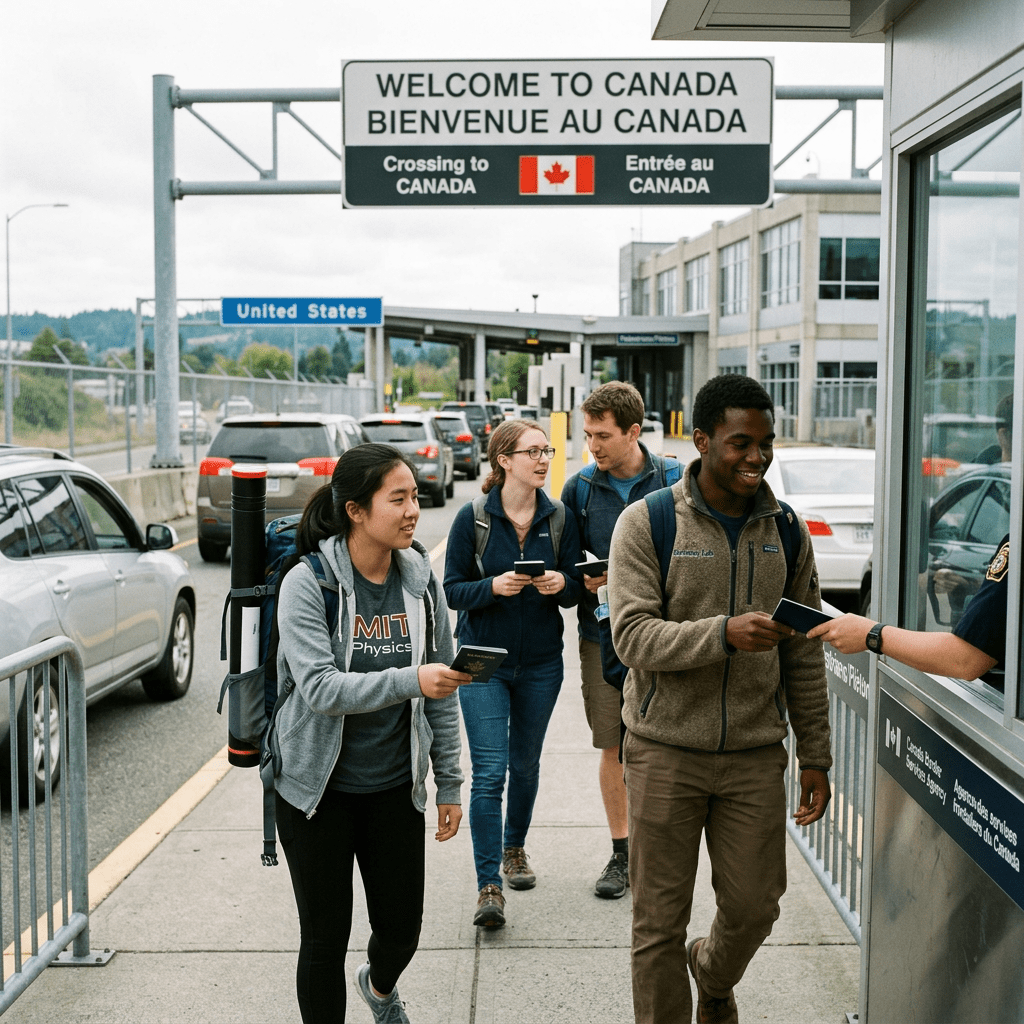
How does what’s happening now connect to what happened in the 1960s and 70s? Then, a single acute shock — the draft — produced a discrete, visible cohort exodus. The border helped: a U.S. driver’s license and a few cursory questions got you across. Physical migration was nearly frictionless, which is why the movement happened quickly and in plain sight.
Today, the mechanism is almost entirely different. There’s no single precipitating event — instead, a slow-motion but accelerating pressure system. NIH and NSF funding cuts and organizational disruption to grant infrastructure. Indirect cost cap threats destabilizing university research budgets. Uncertainty around F-1 and J-1 visas is choking the graduate student pipeline. Political targeting of specific institutions and research areas. None of these is like the Vietnam-era draft. But, together, they are changing the calculus.
Also, there is considerably more friction than in the Vietnam era. A lot of it is in the decision itself. Scientists considering a move are embedded in a complex institutional infrastructure: active grants, dependent trainees, and long-standing collaborations. Leaving requires dismantling all of that. But that same complexity means that those who do make the move are deeply committed to staying on after they move.
The cumulative effect is that the expected value of an American academic science career has declined sharply, especially for early- and mid-career researchers. This isn’t a single push — it’s a dozen smaller ones, which makes it harder to see as a pattern, but no less real.
I should be precise about what I mean when I describe my embassy visits. These aren’t casual social calls. Over the past year, I have been contacted by representatives of several foreign governments — European countries foremost among them, but not alone — with a request that has become almost formulaic: could I identify promising young American neuroscientists who might be open to conversations about positions abroad?
The request is always framed diplomatically. No one uses the word recruit. But that is precisely what it is — organized, deliberate, and sophisticated. These aren’t opportunistic conversations at conferences. They are structured efforts, backed by government resources, to identify and cultivate specific individuals at a specific moment of American institutional vulnerability.
Canada isn’t simply waiting for Americans to show up. It has been actively building the infrastructure to receive them. The Canada 150 Research Chairs program, launched in 2017, was explicitly designed to recruit exceptional researchers from around the world and drew heavily on talent from the United States. The Canada First Research Excellence Fund has made major institutional infrastructure investments that give Canadian universities genuine competitive standing. These created an ecosystem in which the positions are not consolation prizes for Americans who couldn’t land a U.S. position but are first-choice destinations.
There is also a factor that rarely surfaces in policy discussions but matters enormously at the individual level: healthcare. American researchers who leave academia lose employer-tied health insurance. Canadian researchers face no such risk when moving between institutions. In a country where a family health crisis can be financially catastrophic, this is not a minor consideration.
The result is that Canada is playing a long game while the United States is, at the moment, folding its poker hand.
The temptation is to imagine today’s American scientific emigrants as the disaffected — unhappy postdocs, marginal researchers, people who were already looking for the exit. That is not who I am being asked about, and it is not who is going.
The concerning cohort is mid-career: people with established labs, active grants, graduate students, and reputations built over a decade or more of productive work. When they move, they don’t move alone. They take their entire ecosystem — trainees, collaborators, years of accumulated institutional relationships. One full professor emigrating may represent fifteen or twenty years of American scientific investment walking out the door. And the trainees they bring with them, or recruit once they arrive, will become foreign scientists. The pipeline reorients.
The Vietnam parallel holds here with uncomfortable precision. It wasn’t the marginal figures who left and stayed. It was the most able.
This brings me back to the York president’s implicit lesson — the one he wasn’t even trying to teach. Many of the Vietnam cohort didn’t come back.
After Carter’s amnesty, some did return. But roughly half had built lives, careers, and families in Canada, and they stayed. The institutions that had grown around them stayed too.
Why would the current cohort be different? If you have rebuilt your lab in Toronto, enrolled your children in Canadian schools, secured stable funding through one of the Canadian funding agencies, and watched from a distance as American science policy lurches from disruption to disruption — what exactly are you returning to?
Political conditions in the United States may eventually stabilize. But institutional damage takes a generation to repair. The graduate students being trained in Canadian labs today will become Canadian faculty. The networks being built now will be Canadian networks. The scientific culture that is quietly relocating will not quietly relocate back.
The United States has long treated its research enterprise as a fixed asset — something that could be drawn down, disrupted, and defunded without permanent consequence. Brain drain is the market’s verdict on that assumption. Scientists, like capital, move toward expected returns. When the expected return on an American academic science career declines — through funding uncertainty, political interference, and institutional instability — talent moves elsewhere. This is not a political statement. It is an observation about how labor markets work.
What would reverse it? Restored and predictable federal research funding. Visa stability for international students and researchers. A federal posture toward universities that treats them as assets rather than adversaries. None of that is imminent.
I think about the York president on that Kyoto patio, reporting what he had observed without alarm, almost as a casual aside. He wasn’t issuing a warning. He was describing the outcome of a natural experiment that had played out over decades, visible only in retrospect.
I am watching a second such experiment begin, in real time, from an unusual vantage point. And unlike the York president, I’m not describing it in retrospect.
The current cadre of science policy folks in this country worries about research security—stolen intellectual property, occult foreign funding, and the like. They’re not seeing the tsunami: when the human talent isn’t there, research security is airtight. But there aren’t any discoveries, because there aren’t any discoverers.

