A Calm Week

This has been a quiet week here at George Mason–the campus has definitely entered the summer slows, with less traffic (both of the motorized and animal types). This in spite of the campus excitement from our sister institution to the south.

At Krasnow, I’ve taken advantage of the quiet to work on several projects that require reflection, while at the same time, touring laboratories to keep in touch with the various scientific programs at our institute. I’m continually amazed by the research at Krasnow–it’s both imaginative and demanding–exactly what we want at an institute for advanced study.

The weather has seen fit to mark the astronomical solstice by reverting to the normal summer Washington DC pattern of extreme heat and high humidity. It’s definitely a good time for air conditioning.

Next week however things change. I’ll be at the National Science Foundation early in the week for a workshop on convergent technologies and then out to Sandia National Labs midweek for a review of the cognitive sciences program finishing up with a quick meeting at the Santa Fe Institute to talk about future collaborations. If I’m lucky, I’ll get back before midnight on Friday.

I’m hoping to get some good blog posts in from the road to break things up.
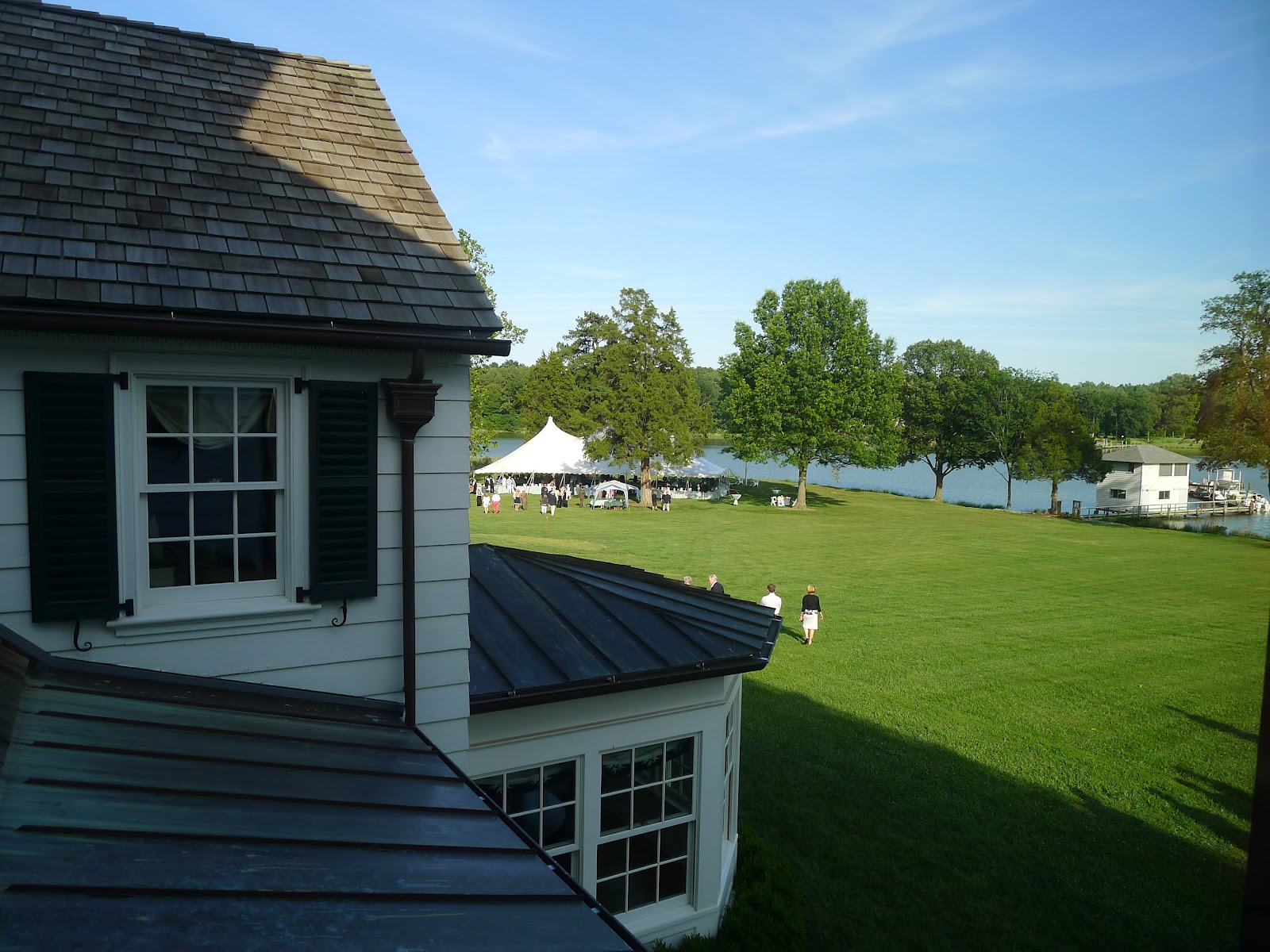
Pickering Creek: A worthy cause….

We helped celebrate the 30th birthday of a wonderful Eastern Shore cause, Pickering Creek, a sanctuary of Chesapeake Audubon Society with over 400 acres of forests, fields, and shoreline. The sanctuary provides wonderful educational opportunities for k-12 students from across the area.

But the house in the foreground is not Pickering Creek! It’s Lombardy Estate, not too far away, but  really one of the eastern shore’s gems. The birthday party was under the large tent, by the water on a day where the weather was absolutely perfect.

I’ll have a little biology with my scifi…

Zen Faulkes’ very entertaining commentary on the biology embedded in the new SciFi movie, Prometheus is here (hat tip to Andrew Sullivan). I also agree with him generally. Although I’d add this: another “watermark” for relatedness would be at the phenotype level: it would be very interesting if alien brains had neurons that conducted action potentials based on ionic conductances.

Neuroscience in China

Nature Magazine has an excellent report here. US National Academy of Science member Moo Ming Poo is leading the way at ION in Shanghai.

Money quote from Poo:

“It’s more exciting, exhilarating here [than in the US],” he says. “They need me. I feel it’s the best use of my life.”

Bethesda Maryland…

I’m headed for a meeting in Bethesda this afternoon. As many readers know, I was a postdoc at the NIH after I graduated with my PhD from Michigan in 1987. I also lived there for six years at a time before 9/11 when the campus of NIH will still wide-open, more like a college than the federal installation that it is.

NIH (and here I’m referring to the intramural program that has a campus in Bethesda) has faced many challenges over the years and has managed to thrive in spite. It’s a place that structurally facilitates the sort of high-risk, high-payoff research made possible by freeing investigators from the need to constantly be writing new grant applications.

When I was there, the real limit on my research was my own imagination– in stark contrast to the challenges that young investigators often face in the academy.

All of this may soon be at real risk as the US faces the so called “fiscal cliff” next January. The biomedical research at NIH is one of the few government programs that has maintained real bipartisan support over the years since the World War II. The reason is of course, that NIH makes a real difference in the everyday lives of Americans and…that it just plain works.