The Annual Science Retreat


This is one of my favorite times of year: our annual science retreat at the Institute for Advanced Study. This year, as with others, we get a fabulous overview of the depth and breadth of the research portfolio at Krasnow. Yesterday’s session featured back-to-back talks, today student poster sessions and a faculty luncheon.

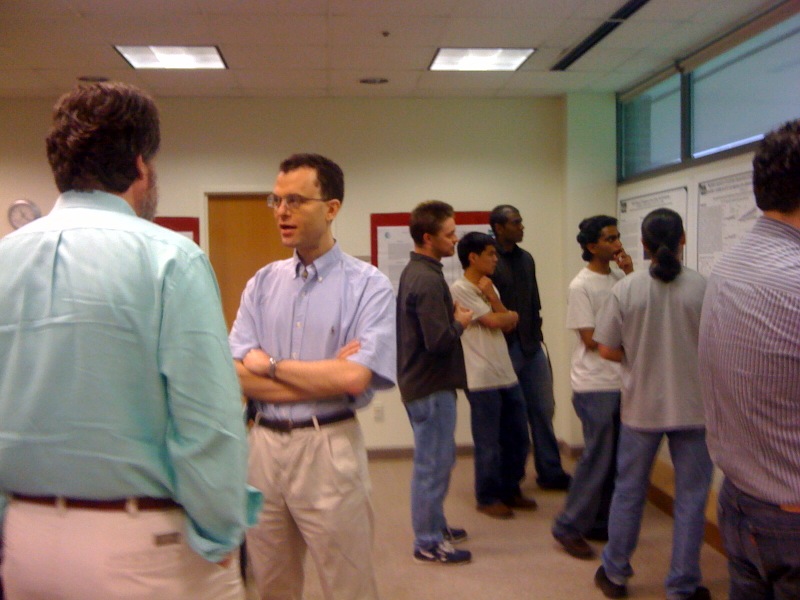
In the foreground here Giorgio Ascoli is engaged in a deep discussion about networks with Claudio Cioffi. Behind them doctoral students and Ted Dumas focus in on a poster.

Craig still makes news….

Genome Pioneer Craig Venter still knows how to make the news. Read about it here.

This time, he’s entirely synthesized the entire genome of a bacterium.
Teaser quote from the New York Times on-line:
At a press conference Thursday, Dr. Venter described the converted cell as “the first self-replicating species we’ve had on the planet whose parent is a computer.”

Olvia Judson’s NY Times Science Blog

I am a very avid supporter of Olivia Judson’s wonderful science blog over at the New York Times (click on the link above). Today she salutes archaea, the third domain of the tree of life. These microbes are both ubiquitous and in many senses unexplored territory as far as biology is concerned–they’re difficult to culture in the laboratory.

Teaser quote:

More diagnostic: archaeal cell membranes have a different structure and composition from those of bacteria or eukaryotes. And although archaea organize their DNA much as bacteria do (they also have no cell nucleus, for example), many aspects of the way the DNA gets processed are distinctly different. Instead, the processing is more similar to what goes in within eukaryotic cells. Archaea also have large numbers of genes that are not found in the other groups.

Commencement and new beginnings

Tomorrow morning is Commencement at George Mason University. As in so many previous years, I’ll arrive early at the Institute, don my academic regalia and walk across the campus lawns to the Patriot Center to join the platform party and mark the end of another academic year.

The carnival of academic regalia reflects the diversity of our faculty, my own bears the markings of the University of Michigan where I received my doctorate. But those of us on the faculty, as we enter the arena, will be swamped by the sea of green, as thousands of Mason students prepare to begin the rest of their lives.
In the end, it’s the ability to positively influence the education of thousands of students, that is the core mission of this large public university. Teaching, this past semester, to both undergraduates and doctoral students, I felt energized by this core mission in a way that both invigorates my own efforts here at Mason as an administrator and that gets leveraged into my role as a science leader at this institute for advanced study.
Already, only the seniors are left on Mason’s campus, some 12 miles from the U.S. Capitol Building. After tomorrow, we’ll settle into the summer routine–for administrators, things only gradually begin to wind down–but I already can’t wait for the Fall semester and the challenges that await: working with my graduate students on research, building out Phase II in our expansion project, teaching undergraduate neuroscience and continuing to edit a 100+ year old scientific journal called The Biological Bulletin.
I feel energized by what’s ahead, just as I feel satisfaction in what’s now past. And I continue to consider this, the best job anyone could hope to have.
Jim

Mobilizing for Phase II

Today, the mobilization began for the next phase in the facility that houses the Krasnow Institute for Advanced Study. Over the next 12 months we’ll be adding approximately 15,000 new square feet of wet labs, core facilities and offices to bring the Institute’s main facility up to about 60,000 square feet.

With our outstanding faculty, programs and staff, we’re well on our way to reifying the vision of our scientific founders.
In the meantime, I’m already thinking about Phase III on the other end of the Institute, to bring our Center for Social Complexity and Department of Computational Social Sciences all under this one roof.
Cheers,
Jim